

By Robin McKelvie, Scotland-based QuirkyCruise Contributor and veteran of 40+ Scottish cruises
Updated October 2026
Scotland is one of the world’s top small-ship cruise destinations. The exceedingly scenic isles off the country's west and north coast are an ideal backdrop for intimate small ship Scottish cruises.
Over the last 15 years I have embarked on over 40 Scottish small ship cruises. I live and breathe Scottish cruise ship travel and have written over 100 articles on small-ship cruising in Scotland for newspapers, magazines and websites across the world, and regularly talk about Scottish small ship cruising on BBC Radio. For a deep dive into how this phenomenon developed see my article on bbc.com/travel/article/20260806-scotlands-tiny-cruises-go-where-others-cannot.
- Argyll Cruising: Aboard the Splendour
Sail the Hebrides or the Firth of Clyde, or both, for world class cruising with remarkable scenery, seafood and wildlife. - European Waterways. Spirit of Scotland, Barge Cruising on the Caledonian Canal
Proper luxury along the deeply historic Caledonian Canal with no danger of seasickness. - Hebrides Cruises: The Hebrides by Hot Tub on the Emma Jane
Award-winning company with three vessels, including the luxurious 10-passenger Emma Jane, which sports a large owner’s suite and an outdoor hot tub! - Hebridean Island Cruises: On the Hebridean Princess
For serious luxury, one of the world’s finest small ship experiences sees you caressed through the Scottish isles - Le Boat: Self-Drive Cruising on the Beautiful Caledonian Canal
For do-it-yourselfers, drive a Le Boat rental with your family or friends. - Majestic Line: Cruising on the Glen Shiel
Glen Shiel is the flagship of this superb independent four-ship cruise line; a brilliant way to explore the Hebrides, the Firth of Clyde and Orkney. - Majestic Line: Cruising on the Glen Etive.
One of the finest small ships cruising the Scottish coast amidst an ever-increasing flotilla of rivals. - Red Moon Cruises: Red Moon Rising
Seriously intimate four-person vessel where you get a major say in the route taken; now operating out of Plockton. - Skarv Lines: Cruise Either the West Coast Aboard Nova Spero
Rugged fishing boat conversion that sails the perennially popular Hebrides.
Subscribe to our monthly small ship cruise email
Subscribe to QuirkyCruise.com for monthly curated newsletters highlighting our top reviews, round-ups & offers!

Robin McKelvie Is A Scottish Small-Ship Cruise Expert
QuirkyCruise contributing writer Robin McKelvie knows Scottish cruising like no other.
“The small-ship cruises I've sampled over the past few years are the most intimate and rewarding way to cruise what for me are the most spectacular cruising waters in the world,” Robin says, adding …
“Each vessel has its own individual character, but all are a sheer joy, from tiny converted fishing boats like what Argyll Cruising offers, through to the relatively large Hebridean Princess, a brilliantly converted former car ferry.
This charming, welcoming flotilla open up the isles sprinkled along Scotland's wildlife-rich west coast — both the Firth of Clyde isles and the Hebrides (Inner and Outer) — in a wave of great food, world-class hospitality and big skies.”
Ok, So Why Should You Consider Small Ship Scottish Cruises?
Quirky's Ted Scull tells us all about why cruising the western waters of Scotland is so wonderful, HERE in this insightful overview.
Is There Anything To Be Wary Of When Considering Small Ship Scottish Cruising?
The Weather Forecast
Quirky Cruise is tied to maintaining honesty, even about the weather. And therefore, we must note that the notoriously fickle weather in Scotland can turn dank and dreary — for a few days or just a few hours.
To paraphrase the great Billy Connolly – there is no such thing as bad weather, only poor clothing’, so come prepared. Sailing segments can be rough, especially out to distant St Kilda, though skippers always do their best to mitigate pitching and rolling. It can be a tricky balance, with enduring a little discomfort bringing life-affirming scenic highlights and wildlife experiences.
Be patient and with some luck, the sun on the mountains (we’ve got about a dozen names for mountains in Scotland in Gaelic and Scots) and the moonlight on the lochs will surely provide a dazzling feast for the eyes.

The country (always refer to Scotland as a country, never a region. Same constitutional status as England and offensive to Scots diminishing to a region) often defies its changeable reputation and can be sunny and even a bit too warm, with no air conditioning to help out.
On the other hand, the sweeping moors and lush gardens need to maintain their beauty by being watered. And water is the most essential ingredient in whisky.
Wetter cruises offer the chance to snuggle-up aboard enjoying the cozy (in Scots ‘coorie’) lounges and library and savor more time with the locals who are often on the ships. And when ashore, choosing destinations that include indoor visits to a castle or stately home.
And there are always in between periods where the wet may be referred as Scottish mist (if we’re going for this cliché, it’s always Scotch mist, not Scottish mist), though it’s often a slight understatement. Also, keep in mind, there could be a wee (or more than a wee) bout of rocking and rolling in the waters off of western and northern Scotland, so sea legs will help.
Eat, Drink & Be Merry On Small Ship Scottish Cruises
Scotland is known for Scotch whisky and haggis, a popular combo of the locally produced drink and the national dish, with probably the closest equivalent for the latter being famous in Pennsylvania Dutch country — scrapple.
Haggis ingredients are usually sheep-based while the latter, pigs. Either way you’ll have no problem, though if you read the label the parts used may cause some a hesitation or even a full stop. If you eat sausages, haggis won’t really be an issue, as it is basically minced offal with oats and delicious spices.
Scotland is well-known for its beef, lamb and venison on land and salmon, halibut, clams, langoustines, lobster, mussels, oysters, and scallops from the local waters.
This video below shows how festive the presentation of haggis can be on small-ship Scottish cruises!

Scottish Whisky (Note NEVER whiskey, that is Irish!)
To Scots and devotees around the world Scottish whisky is quite simply the finest distilled liquor on the planet. The prime choice is a single malt – the product of a single distillery matured for at least three years in oak barrels, usually either ex-bourbon or ex-sherry.
Visiting a distillery is a cruise highlight with a sweep of them within walking distance of tender landings, such as Talisker on Skye, Tobermory on Mull and impressive newbie Ardnamurchan on the eponymous peninsula. Look out too for the fine Scottish ales that most small cruise ships stock; local gins too.
RELATED: Ted shares an overview of small ship Scottish cruising.
Scottish Cruises Boast Lovely Lochs
Cruising into a loch, an arm of the sea, or a lake, is a highlight of any cruise. Loch is a Gaelic word also used in the Irish language; though the Irish use lough not loch.
One of the best known is Loch Lomond which is not connected to the sea but is an inland 24-mile-long loch that can be explored in a private-hire local day boat.
Loch Ness, home to the legend (is there or is there not is fun to consider as you cruise across?), is also inland. And to reach it by water, one cruises into Loch Linnhe that leads to a canal lock that accesses several inland lochs, one of which is Ness. Then onward, the boat eventually deposits you near Inverness on the North Sea side of Scotland. Or vice versa.
The tranquil Caledonian Canal is a popular small-ship cruise, especially if you are prone to mal de mer, when in choppy seas.
Cruises may start from Inverness on the east coast or from a port such as Oban on the west coast. Small ships generally don’t cruise the east coast as there are far fewer islands and the scenery (although still unrelentingly eye-catching) is not as spirit soaringly dramatic as the western, or northern, littorals.

The Isles Of Course Are The Whole Point of Small Ship Scottish Cruises
Then there are the islands, more than 800 of them, and Scotland identifies them in terms that will be familiar to many readers.
Scotland's Islands are subdivided into the Inner Hebrides and Outer Hebrides or collectively, the Hebrides. There are also the islands of the Firth of Clyde and the Northern Isles (comprised of the two large archipelagos of Orkney and Shetland).
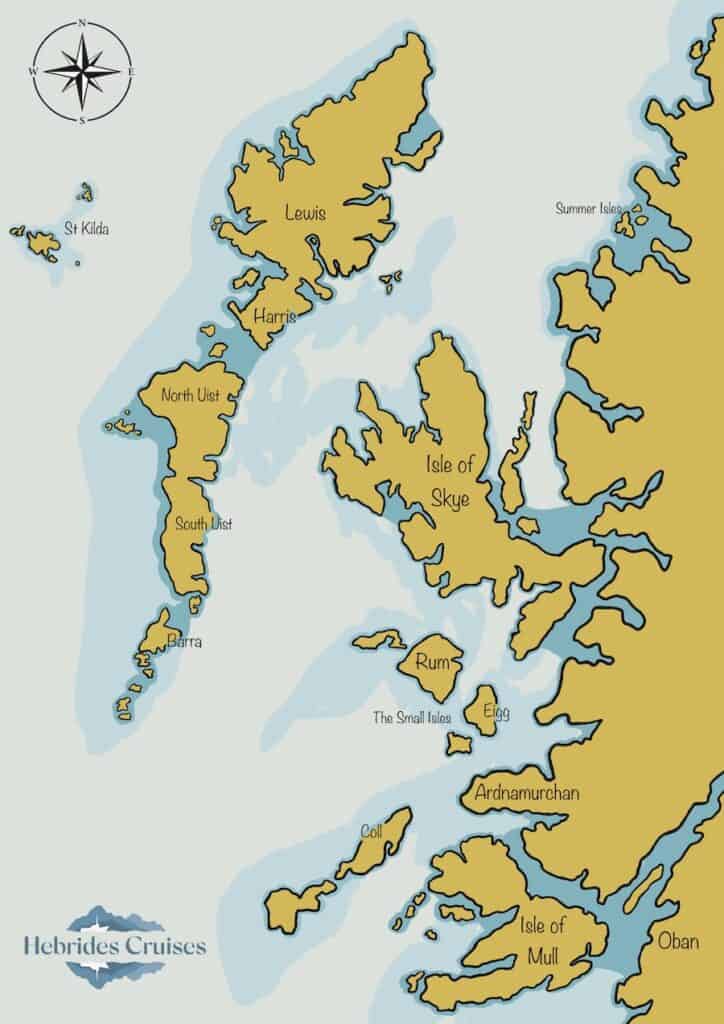
In Scotland, the description “Western Isles” solely refers to the 130-mile Outer Hebrides archipelago, and not the Inner Hebrides (including Skye) or Firth of Clyde isles. All three of these archipelagos lie on the west coast.
Most small-ship Scottish cruising explores just a small portion of this large area off Scotland's western coast, anchoring off terra firma or docking to access the local points of interest, then finding a sheltered bay to anchor for the night before heading to another isle the next morning.
Tendering ashore is the norm, usually on to a small quay, with some beach landings/pick ups when conditions necessitate it. These exhilarating beach operations can actually be a trip highlight.

Eigg. A highlight amongst the Inner Hebrides is community-owned Eigg, the island site where in 1577 the MacLeods massacred 395 MacDonalds in a cave, while the more peaceful sites are an Iron Age fort, a 6th-century church and Viking burial mounds. This community-driven island success story is one other Scottish islands look enviously at — the community ownership of the island in 1997 and have not looked back with the population booming, a brewery with a taproom (opened in 2026) and a record label, as well as an impressive community and leisure hub. It is a life-affirming model for what Scottish islands can be if they’re allowed to run their own affairs, rather than have their lives dictated to by absentee landlords, as is all too often the case in a country where 50% of the land is owned by 500 (mainly) men.
If you want to see the MacLeod’s ancestral lair, Dunvegan Castle on Skye reveals 800 years of history, with a private quay for tender arrivals
Iona is a pilgrimage destination where the Irish prince and missionary St. Columba landed in AD563 to start his community. A religious community still thrives here today. Also of interest is a restored 12th-century abbey. Lovely white sand beaches and easy walks tempt too.
Muck, in spite of the name, has beautiful beaches and provides a bird sanctuary for fulmar, kittiwake, puffin, sea-eagle and shearwater, and porpoises that gather close to shore. It's a great island for beach landings.
Mull is a scenic island, whose waterfront town of Tobermory beguiles with its pastel-hued historic houses. It’s great for walkers and hikers, with miles of trails drawing you out onto the undulating moors and sweeping mountains. Mull’s coastline is so indented that it measures an unbelievable 300 miles. It's a popular stop, especially in poor weather, as the Sound of Mull and its offshoots offer superb shelter.
Skye is easily the most popular of the Inner Hebrides. The most impressive of Scotland’s mountains — the jagged Cuillin — are the stars of the show. Then there are dreamy Fairy Pools, dramatic Kilt Rock and the otherworldly rock formations of the Quiraing. Portree is up there with Tobermory for the title of the prettiest town in the Hebrides, with its similarly pastel-hued stone houses. And numerous souvenir shops and wee galleries.
Amongst the Outer Hebrides are Lewis, the largest and most northerly island when paired with connecting Harris. It’s home to the famous Harris Tweed (look out for the official orb symbol). The former features a rugged terrain that rises to 1,800 feet revealing extensive peat bogs. The latter boasts some of the finest beaches you will ever see.
The attractions for many are the Callanish Standing Stones and Dun Carloway, broch that dates back into murky prehistory. The only real town is the cultural hub of Stornoway with ferry connections to mainland Scotland at Ullapool.

St. Kilda, about as far away from the mainland you can get, yet was astonishingly occupied for 5,000 years until the dwindled-down population of less than two score left forever back in the 1930s.
What remains is an outdoor museum of an abandoned village, roamed by sheep, and with massive cliffs that house up to a million birds during the peak summer season. Epic hiking too.
St. Kilda’s location, with the open Atlantic lurking just behind, makes it a weather-dependent landing. It's impossible to moor overnight in an easterly.
I’ve been lucky venturing out to St Kilda archipelago six times — with Hebrides Cruises, Hebridean Princess, a Russian research ship, a kayaking trip and a National Trust for Scotland charter. I have managed to land five times. I fully appreciate just how rare this is, as any form of easterly wind and it rules the only decent harbor of Village Bay out. My late sailor dad sadly never made it here. Crossings tend to be rough so take your seasickness tablets if you’re in any doubt about your sea legs. This mind-blowing archipelago is well worth the effort.
Wildife of The Hebrides — What To Expect
Our friends at Hebrides Cruises share some insights into the wildlife of the Hebrides, below.
The Hebrides is one of the finest wildlife watching destinations in Europe, and no two cruises are ever quite the same. Here is a flavour of what you might encounter throughout the season:
Spring & Early Summer (April – June)
From late April, thousands of puffins return to the Treshnish Isles and St Kilda, famously curious and often just feet from your boots. Listen for the rare corncrake on Iona, watch Manx shearwaters returning to Rum, and keep your eyes on the clifftops of Mull for white-tailed eagles – with an eight-foot wingspan, they are impossible to miss.
High Summer (July – August)
Basking sharks, the world’s second-largest fish, appear as the waters warm in mid-July. Minke whales, common dolphins and harbour porpoises are seen on almost every cruise, while the waters of the Outer Hebrides offer the chance to spot rarer species including Risso’s dolphins and even orca. In late August, the waters off Ardnamurchan come alive with thousands of gannets and guillemots diving into shoals of fish, often joined by leaping dolphins and lunging minke whales. We also head to Northern Minch in search of the bigger whales like Humpback and Fin Whale and are always keeping an eye out for the 2 famous West Coast Community Orca too, John Coe and Aquarius!
Autumn (Sept – October)
The hills turn to gold and the red deer rut begins, one of Scotland’s most dramatic wildlife spectacles. A great spot for this is Loch Etive. Atlantic grey seal pups appear in sheltered anchorages, and the light for photography is simply amazing.
Year-round Highlights
On a typical cruise, guests can expect to encounter minke whales and harbour porpoise, common and bottlenose dolphins, white-tailed and golden eagles, otters, seals and red deer, alongside over 60 species of birds. Wildlife isn’t a happy accident on our cruises: it is the very purpose of the journey.
“Part of the adventure is not knowing when the wildlife will appear, but if it’s there, we have the expertise to find it.”
— Lynsey Bland, head wildlife guide for Hebrides Cruises

Oban, Along The Western Coast, Is Scotland's Most Important Cruise Port
Many small ship cruises, most based in Scotland, leave from the modern pontoons in Oban, with ferries to the nearby islands leaving from the ferry terminal across Oban Bay.
The attractive port is a busy destination in the summertime. McCaig’s Folly, a hilltop mini-Colosseum, presides over Oban from a high bluff, and the view from there is outstanding. Scotland’s busiest ferry port also sports a renowned eponymous distillery, lively pubs and superb seafood eateries. The green and white shack on the ferry pier is the place for boat-fresh shellfish; perhaps the best value seafood in Scotland, so don’t miss it.

Pick your cruise from a plethora of choices with berth capacities as low as four and on up the scale, but still a quirky cruise.
Book as individuals or better yet, think about chartering the vessel for a family gathering or a small group of friends.
Other cruises on larger ships will visit the isles off Scotland's western coast as part of a longer cruise but they won’t usually be crewed by locals. Most small cruise ships have a mix of Scottish and rest of the UK crew.
Some travelers like spending some time riding the rails before or after a Scotland cruise, via the modern state-owned Caledonian Sleeper trains say, from London to Glasgow, to spend a few days in this destination-rich city and then continue by train to the cruise port, mostly likely Oban. The Caledonian Sleeper is a Scottish Government owned service that saves on a night’s accommodation and enhances your vacation. If that is, you book one of their cabins with beds rather than a seat. A wee dram before bed in the bar car is de rigueur.

RELATED: Ted shares an overview of cruising Scotland's Western Isles.
So Are You Convinced That Going Small in Scotland Is The Way to Go?
If the answer is yes, here's a list of the small ship Scottish cruises Robin has reviewed for us in recent years (with some fresh notes and updates from him in parentheticals); we also share a few reviews from other writers.
- Argyll Cruising (New owner in 2024, Ted Creek, has been a breath of fresh sea air. Similar routings as before with the ship refreshed and improved; the food lifted a notch too.)
- Spirit of Scotland Canal Barge (Proper luxury along the deeply historic Caledonian Canal with an outdoor hot tub; much better than her less luxurious sister ship Scottish Highlander.)
- Hebrides Cruises (Award-winning family-run company who have upped the luxury in recent years, but kept the informal friendliness; they now have three ships.)
- Hebridean Island Cruises (Simply the most luxurious way to cruise the Hebrides on a unique heritage ship, Hebridean Princess, much beloved of the British Royal Family; second vessel is Lord of the Glens; third is Lord of the Highlands.)
RELATED: Ben Lyons reviews his Hebridean Princess trekking-focused cruise.
RELATED:Pat Dacey reviews hisLord of the Highlands cruise.
RELATED: Judi Cuervo reviews her Hebridean Princess cruise. - Majestic Line (They've got new owners and now have a fleet of four ships with a fifth vessel already planned for 2028 according to co-owner Colin Craig. The new owners have really made their mark.)
- Red Moon (Husband and wife team still going strong, recently relocated to a new base further north at Plockton.)
- St. Hilda Adventures. (They've added a fourth vessel, the Speideren, which looks like an old Norwegian rescue vessel like the Elizabeth G from Hebrides Cruises. I’ve only been on their St Hilda and was not overly impressed. Bunk sleeping, and we had to help with tenders and help with the dishes!).
- Skarv Lines (This line has a ingle vessel, no new ships, no major changes of late; though note they discontinued their east coast sailings, however they are the only line going to Shetland.)
And … here is a review of a quirky small-ship Scottish cruise line that Ted suggests you check out.
So there you have it, hope you enjoyed our in-depth exploration of small ship Scottish cruises. Choose one if you want to experience what I, as a travel writer specializing in cruise travel, who has sailed all the world’s oceans, genuinely consider the finest cruising on the planet.
Expect an intimate, authentic experience cheered by likeminded open-minded souls, enjoying world-class food and whisky, wrapped in epic scenery and jaw-dropping wildlife. What are you waiting for?
Interested In A Scotland Cruise?
For years, we've been referring our readers to our favorite travel advisor, Kevin Flink, because of his excellent customer service and expertise in travel planning. Kevin owns a franchise of Cruise Planners, one of the highest producing land and cruise travel agencies in the world, which means he gets access to various discounts and perks from cruise lines, hotels and insurance companies that he can pass on to his clients.

To show your interest in booking a small-ship Scotland cruise (or any cruise!) with Kevin, please tell us a bit more about what you’re looking for and we will be happy to get you both connected.
* Your personal information will be used solely for purposes of responding to your request.

Don’t miss a post about small-ship cruising, subscribe to QuirkyCruise.com for monthly updates & special offers!
© This article is protected by copyright, no part may be reproduced by any process without written permission from the author. All Rights Reserved. QuirkyCruise.com.













 HEIDI SARNA


Very cool to see all these sites and options. I was in Scotland many years ago but realize there is much more to see, especially all the isles and remote locations on the western side. Although I’m not sure I’m up for trying haggis again (but maybe?), I would love for some beautiful hiking and see the wildlife in the lush green rolling hills near these old historic villages. I’ve never heard of Muck and Mull, but they seem very inviting to me. Thanks.
So glad you found our round-up useful! Scotland’s western isles are breathtaking, rain or shine!
one of the photos of “St Kilda” is of Rockall.
Thank you John for letting us know. 🙂