
8 Rough Cruising Regions
By Ted Scull.
Updated June 2025
🎧Would you rather listen to this article about the roughest cruising regions? Below Ted shares his rough sailing stories and tips. (15.35 mins)
Now let’s begin with the good news.
Advance weather forecasts give ship captains ample warning to steer clear of a hurricane’s track by altering course.
A diversion may result in skipping a port or two and substituting others, and while you might still feel the swell from the storm, it is unlikely that the ship’s movement will be more than a gentle rise and fall.
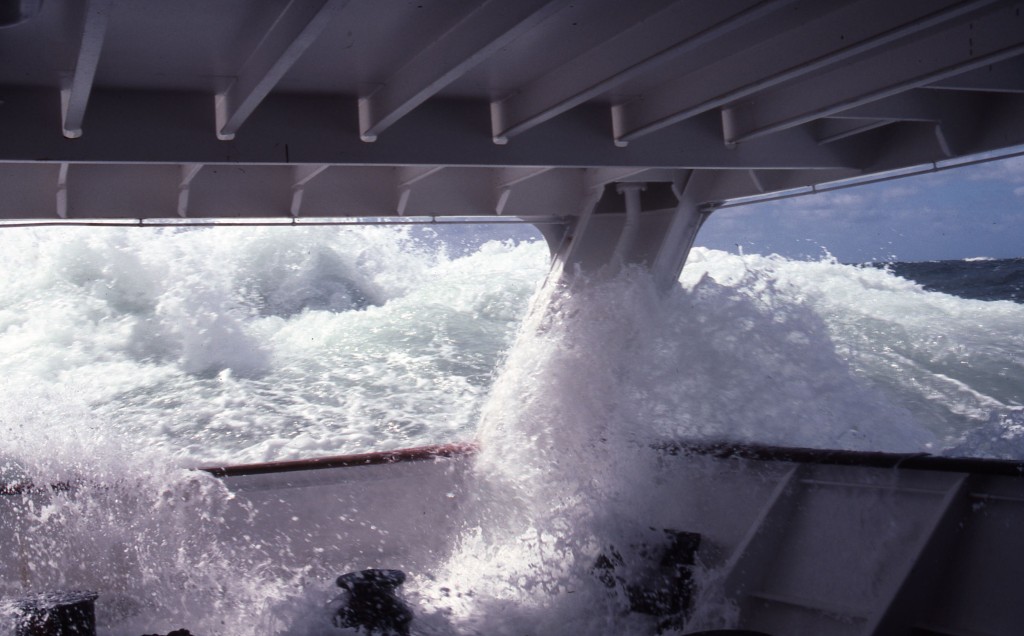
Stabilizers help reduce side-to-side rolling, but not the up and down pitching motions into oncoming swells. The smaller the small ship, the less likely it will have the stabilizing fins.
Large cruise ships' massive blunt bows tend to slam into head seas, and to lessen the unpleasant sensation, the captain may drastically reduce his speed to lessen the impact.

The bodies of water below have the potential for the being the choppiest in world.
In no particular order, here are 8 rough cruising regions:
1. Caribbean Ocean Believe It Or Not
The Caribbean’s hurricane season (around June to October) tops the list in terms of the number of passengers potentially affected because of the large number of ships cruising here. However, with so many alternative routes and ports of call, in most instances, ships can avoid the storm's fury and still provide a satisfying cruise.
Learn more about the best small ship cruises in the Caribbean.
2. North Atlantic Has a Reputation as a Tough Cruising Region
The North Atlantic is notorious for its storms at almost any time of the year, and the further north the track the more likely it is to encounter some rough seas along the multi-islands’ passage between the North of Scotland, Shetland/Orkney, Faroes, Iceland, Greenland, Newfoundland and the Canadian maritime provinces and/or the U.S. East Coast.
It is positive thinking to note that all islands have a lee side.
The ships that reposition seasonally via the Atlantic between the Mediterranean/Iberia and the Caribbean/Florida are much less likely to encounter storms.
However, ships that sail between Northern European ports, Iberia and the Mediterranean pass through the Bay of Biscay. This body of water, west of France and north of Spain, has a long anecdotal history especially with Brits, of being a very rough cruising region:.
In my experience — 16 passages — only one (Santander to Portsmouth) was truly tempestuous and that was quite enough for everybody on board, including me who likes a bit of chop.
Get the latest small ship cruise reviews in the North Atlantic.

Subscribe to our monthly small ship cruise email
Subscribe to QuirkyCruise.com for monthly curated newsletters highlighting our top reviews, round-ups & offers!
3. The Mediterranean Can Get Heavy at Times
Speaking of the Mediterranean, the Mistral that roars down the Rhone Valley in France and then across the Western Med can stir up heavy seas in winter and spring as does the Meltemi in summer in the Greek Islands.
I was aboard the Royal Clipper during a powerful Mistral and the sail-laden ship reached its maximum hull speed. It was exhilarating and more than a bit dramatic.
Check out the best Mediterranean small ship cruise reviews.
4. Drake Passage is a Notoriously Rough Cruising Region
The dreaded Drake Passage between Ushuaia, Argentina and the Antarctic Peninsula has a well-deserved reputation, and happily any storm that does occur rarely lasts more than 12 to 24 hours.
If you are susceptible to mal de mer, be prepared to deal with any eventuality because the expedition is well worth it.
Longer itineraries that include the Falklands and South Georgia expand the chances for stormy weather, qualifying the area as potentially a very rough cruising region.
Read a bunch of Antarctica cruise reviews here.
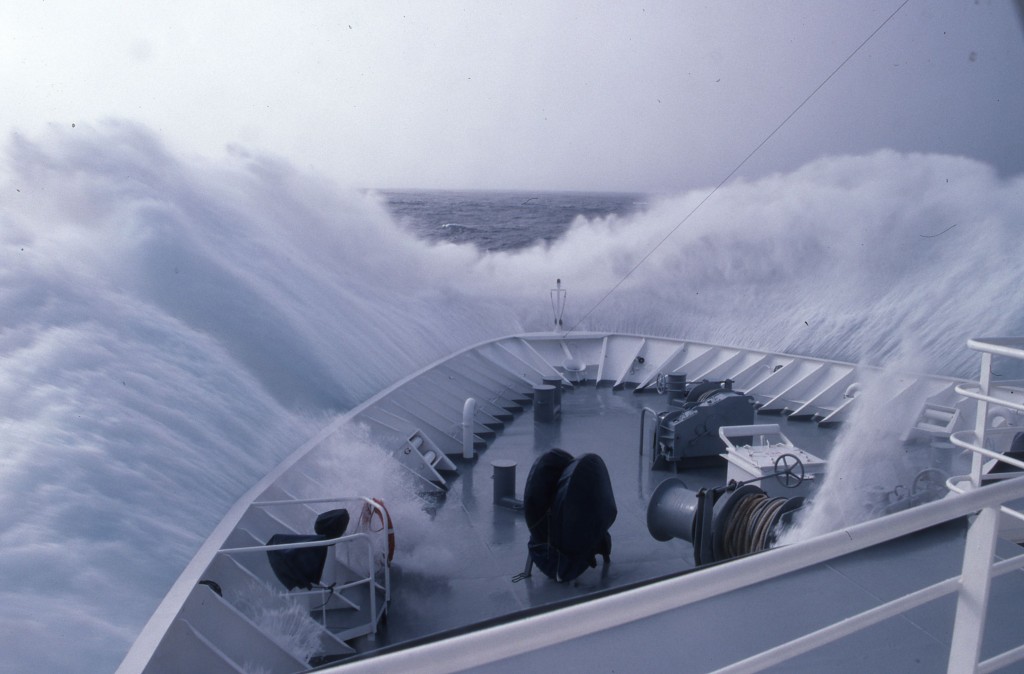
VIDEO: QuirkyCruise Contributing Writer John Roberts shows us more about rough Drake Passage crossings in his video:

5. Gulf of Alaska Indeed
The Inside Passage to and from Alaska may be well protected apart from a few short-open sea stretches, while small cruise ships traversing the Gulf of Alaska to Seward, on the other hand, may encounter North Pacific storms or swells from a more distant storm.
6. Southeast and East Asia Can be Affected by Monsoon Activity
Typhoons are an occasional worry in Southeast and East Asia from the South China Sea north to Hong Kong, South Korea and Japan, but course alterations can minimize discomfort unless the ship must call at a disembarkation port, then arrivals may be delayed until the waters calm.

7. Trans-Tasman Passage Can Be One of the Roughest Cruising Regions
The Trans-Tasman passage between Australia and New Zealand and the Bass Strait between Southeast Australia and the island of Tasmania can kick up a mighty storm (Heidi experienced this first-hand on a cruise some years ago and the banging of the waves on the hull was epic!); rest assured, few small ships venture into these southern waters.
8. Point Judith is a Rough Cruising Region
The only time I ever felt I might be seasick was standing at the bow of a small ship rounding Point Judith where Narragansett Bay meets Long Island Sound. The sea becomes confused here due to colliding waters, and by simply moving amidships, the unpleasant sensation eased.
Charles Darwin was seasick more than not during his three-year voyage on the Beagle, but back then there were few remedies, and today they are many.
A truism is that everyone reacts differently, so there is no easy answer. Still, for the small percentage that do experience mal de mer, it is no picnic. Get professional advice before you go.
Hope you enjoyed our deep dive into eight of the world's rough cruising regions.
Interested In A Calm Cruise?
For years, we've been referring our readers to our favorite travel advisor, Kevin Flink, because of his excellent customer service and expertise in travel planning. Heidi first met Kevin on a small-ship cruise in Alaska and they bonded over their shared passion for quirky cruising!
Kevin owns a franchise of Cruise Planners, one of the highest producing land and cruise travel agencies in the world, which means he gets access to various discounts and perks from cruise lines, hotels and insurance companies that he can pass on to his clients.

To show your interest in booking a cruise with Kevin, please tell us a bit more about what you’re looking for and we will be happy to get you both connected.
* Your personal information will be used solely for purposes of responding to your request.

Don’t miss a post about small-ship cruising, subscribe to QuirkyCruise.com for monthly updates & special offers!
© This article is protected by copyright, no part may be reproduced by any process without written permission from the author. All Rights Reserved. QuirkyCruise.com.










 HEIDI SARNA



Planning a cruise from NY to New England to Canada to Greenland to New foundland.How rough is the sea? Any comments are appreciated
Dear Geza,
Thank you for your question about rough seas. I have cruised the waters between Greenland and Newfoudland twice, both in the summer time on small ship, and encounted minimal rough seas, and between Newfoundland, New England and New York numerous other times, in many different months, and have experienced everthing from pea soup fog, dead calm, some moderate swells and both gale and hurricane force winds. Happily, I am a good sailor.
There is no set answer as North Atlantic weather is highly unpredictable with the calmest months usually being June, July and early August. But nothing is as usual as it used to be.
If you are prone to sea sickness, make sure you are well prepared with recommended remedies and where to be on the ship depending on the movements – pitching up and down or rolling. If the ship has stabilizers thaat is a big help with minimizig rolling.
I wish you well and with calm seas.
Ted
Hello
I am cruising with a group in January Mauritius to Singapore via Maldives, Seychelles, Reunion, Madagascar, SriLanka. I have been trying to find what sea conditions to expect but having trouble locating anything.
Anne
The Indian Ocean as a whole is generally a smooth-sailing region, though the annual monsoon season can cause large swells in the Arabian Sea and along the western Indian coast.
I have sailed these Indian Ocean waters four times, and only once has it been rough (see above) Otherwise., the swells have been gentle, along the East African coast and amongst the Seychelles.
I hope that helps