
Bella Desgagnés Cargo Passenger Cruise
By Aimée Laberge
Natashquan, Harrington Harbour, Tête-à-la-Baleine, La Tabatière, Saint-Augustin, Blanc-Sablon… Why on earth would you head out on a supply ship to isolated villages on the Gulf of St. Lawrence’s northernmost coast? I think, in one word, l’aventure, because adventures are in short supply in our daily lives, aren’t they?
I acquired a taste for l’aventure during a work cruise onboard the Canadian Coast Guard Ship Amundsen, the first scientific icebreaker in the world to spend the winter beset in ice near the Beaufort Sea. I joined 40 crew members from Quebec and 40 researchers from all over the world as we went from cruising in open water to breaking ice on our way to the overwintering station.
Once the ice shelf was thick enough to support us, we started to dig for ice cores, set up a STOL (short take off and landing) aircraft runway, watch daily northern lights and go for wild snowmobile rides. I moved on to other cruises later with more elaborate dress codes, but always missed the camaraderie and sense of purpose from this first experience.
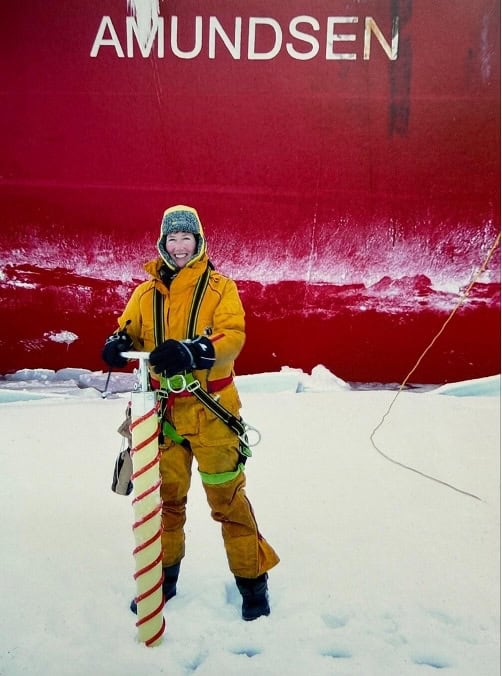
Aimée Laberge. * Photo: Aimée Laberge
This is why, now that my husband and I benefit from the 65+ discount, we booked a week-long cruise onboard a small freighter with a mission to supply hamlets not reachable by road in northern Quebec. What I learned early on the CCGS Amundsen is that global warming is man-made and pollution spoils even the most remote places on earth.
The Bella Desgagnés is eco-responsible, leaving the smallest possible carbon footprint on the environment, and collaborates with two research projects: the Marine Mammal Observation Network, and MARS, the Marine Acoustic Research Station studying the impact of the maritime traffic noise level on whales.
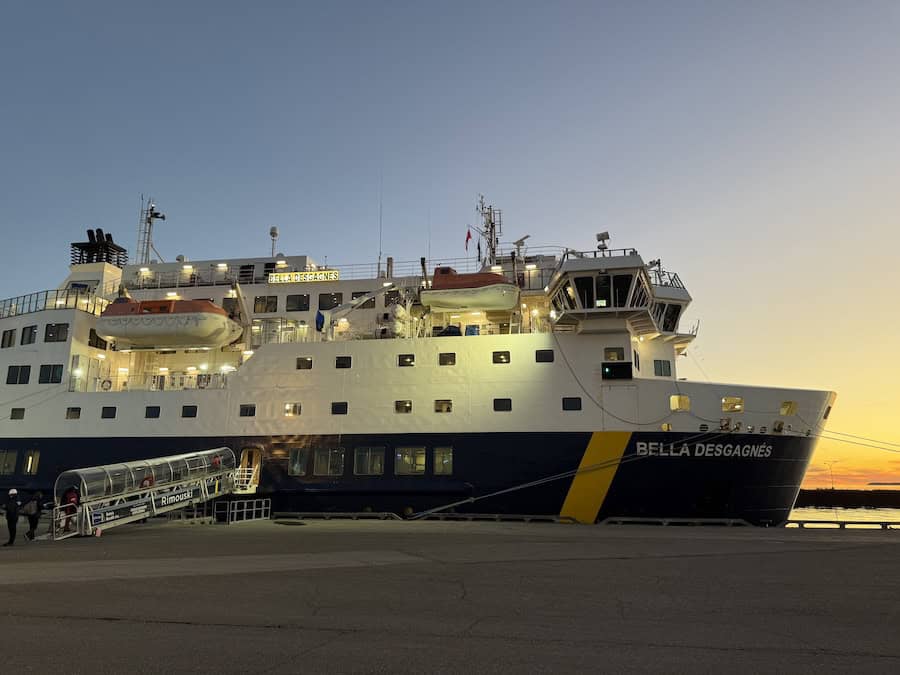
The Bella Desgagnés cargo passenger vessel operates in the Gulf of St Lawrence. * Photo: Aimée Laberge
What Is This Cruise All About?
The Bella Desgagnés is a 63-cabin (126 passenger) cargo-passenger ship operated by Relais Nordik (Groupe Desgagnés) supplying remote communities along the lower north coast of Quebec in the Gulf of St-Lawrence; the company is ISO14001 and Green Marine certified and committed to sustainable tourism.The ship has anti-roll tanks and stabilizers, has a Class 1 AFS ice rating to navigate in winter and is equipped with a 35-meter-high crane.
The seven-night cruise round-trip from Rimouski (in the province of Quebec, Canada) typically features about 10 additional stops — including at Anticosti Island, a UNESCO World Heritage site. The ship stops twice in each location, once on the way out and once on the way back. Locations where the ship stops at night on the way out will be visited during daytime on the way back. The exact number of stopovers could vary due to weather and other conditions
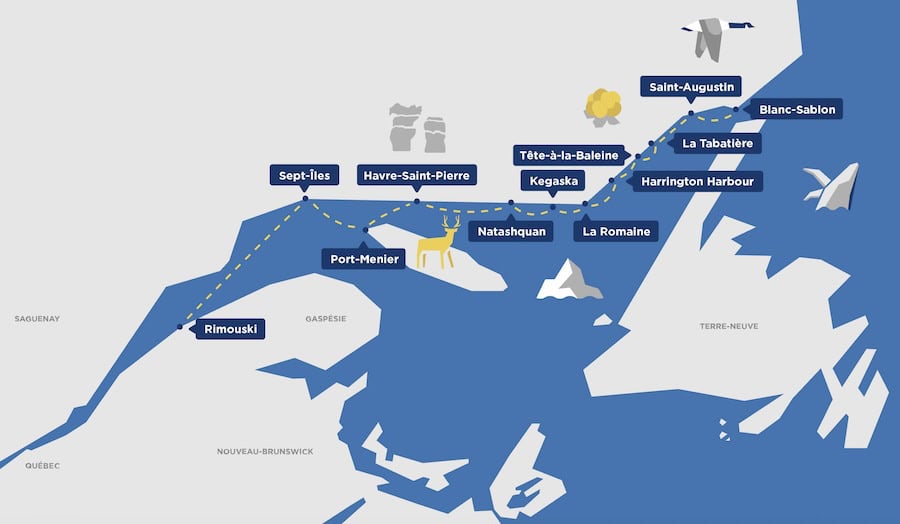
The 7-night cruise includes 12 stopovers. * Image: Aimée Laberge
Reasons to Do a Bella Desgagnés Cargo-Passenger Cruise
- Experience a small-ship adventure through uncharted territories and unspoiled landscapes with a comfortable cabin and three great meals a day.
- Learn about the history and the culture of the French, English and Innu communities visited.
- Witness the Bella Desgagnés’s essential mission to supply hamlets not reachable by road in northern Quebec.
- Follow the ship’s operations first-hand and learn more from the captain and the crane operator’s presentations.
- Observe marine mammals at sea, and the local fauna and flora on land with two naturalists onboard.
5 Caveats
- English-speaking passengers on-board are a minority, with all information and communications available in English and French.
- Presentations are given in French in the Bistro, with the English version given in the smaller boardroom.
- Schedule is driven by the ship’s mission. Stopovers range from 30 minutes to two hours, and can conflict with mealtime.
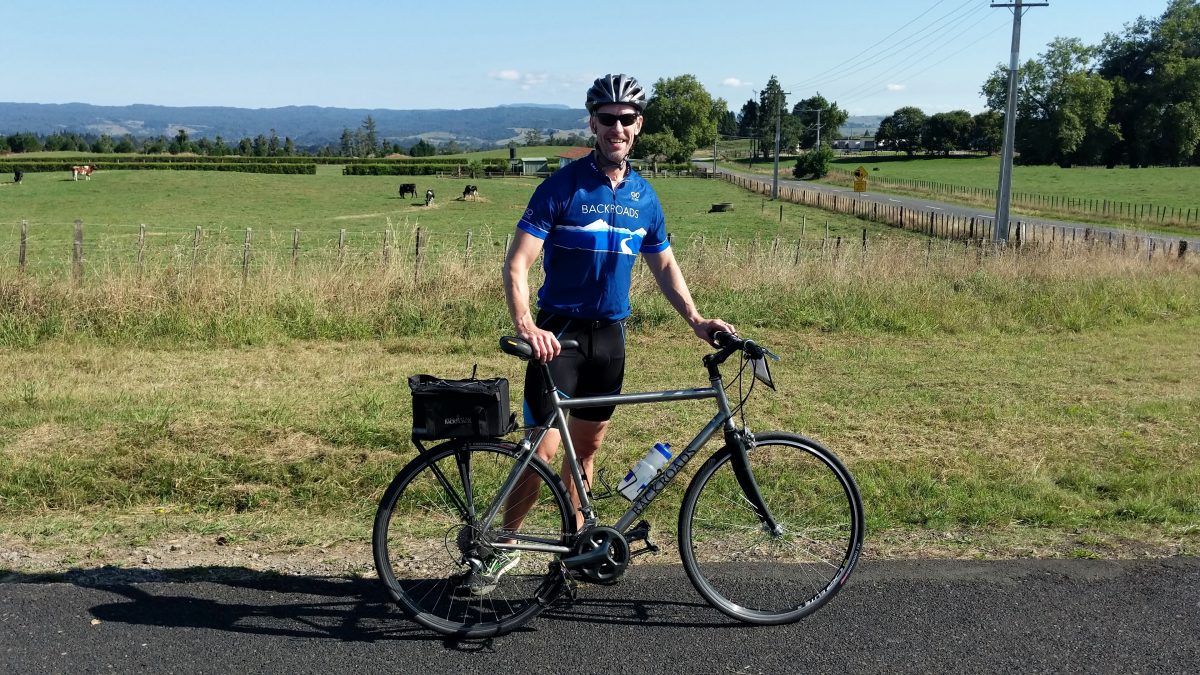
- Villages can be far from the dock, with limited means of transportation available. Bicycles welcomed on-board. Hitching a ride with the locals is a great experience!
- Weather conditions can interfere with operations and stopovers.
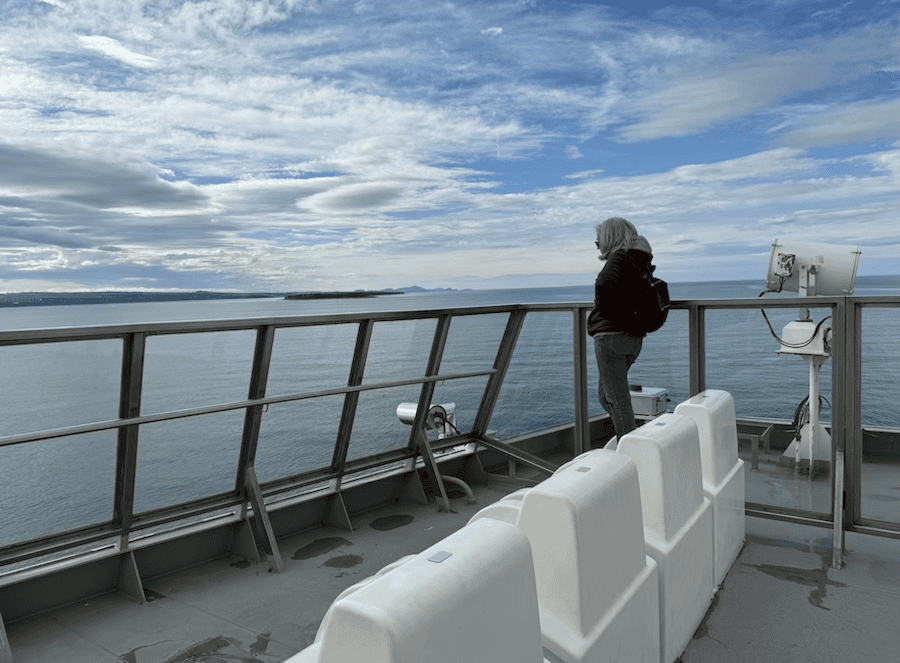
Checking out the scenery from the Observation Deck of the Bella Desgagnés. * Photo: Aimée Laberge
Day 1
- Rimouski — founded in 1696; population 50,000
- Boarding 6pm
All aboard, finally. After watching, mesmerized, cars, tractors, cement, hay, all being loaded in containers on the Bella Desgagnés, we walk up the gangway with our rolling suitcases (max. 44 pounds per passenger) and are directed to our cabins as the sun sets.
Cabins, Decks, Meals & More
We love our superior cabin on Deck 5.
It’s not luxe but it’s spacious with an amazing amount of storage, a large window, a couch, a TV with US channels and a wireless charger. No double beds on this ship but two bunks that can become four if needed. Also surprising: how well insulated it is from the ship’s engine noise.
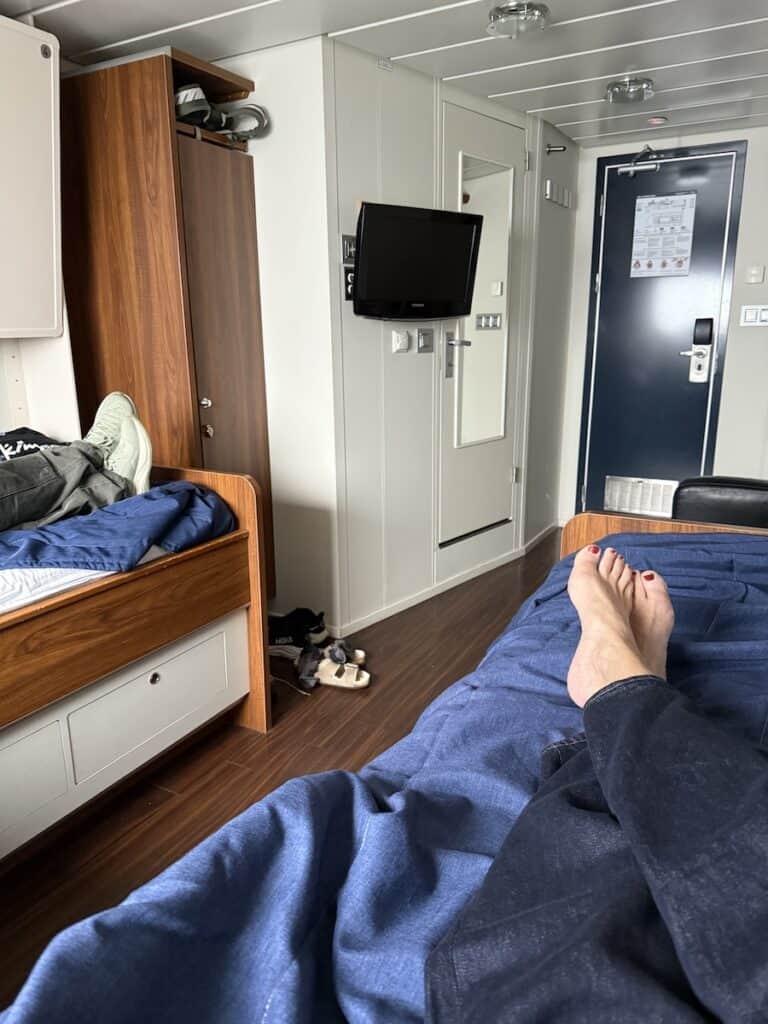
Cabin chill time. * Photo: Aimée Laberge
The heated floor and efficient ventilation in the bathroom mean towels or rain-drenched gear dry up really fast. Towel service is on request keeping up with the ship’s sustainable development policies. Light daily cleaning is offered.
Note, the Bella Desgagnés has two wheelchair-accessible cabins. The ship has an elevator; though getting on and off the gangway can be slow going with a wheelchair, the crew make it work.
VIDEO: Below, Aimée gives us a tour of her cabin.
https://youtube.com/shorts/h9i-9UU3nvY?si=Hm4PfoIZGTqYt4Qn
Our favorite beverage, Sauvignon blanc for Madame, and local bière rousse for Monsieur, are available for purchase during the information session in the Bistro on Deck 8. Out of 80 passengers, mainly from Quebec, some from France, six are English-speaking. But not to worry: purser Charles Antoine or crew member Paul make sure they received all the information needed for life onboard.
Ship Stewart Roberto Thomassin explains the meal schedule. We are Group 1with breakfast at 7 am, lunch at 11:30 am, and dinner at 5 pm. For Group 2, breakfast is at 8:15 am, lunch at 12:40 pm, and dinner at 6:40 pm. Miss breakfast, or any other meal? No problem. The cafeteria is open from 7 am to 10 pm, and the Bistro (drinks only) from 3 pm to 10 pm.
Roberto also explains that the ship will do all 12 stopovers from Rimouski to Blanc-Sablon, and again when we return. The stops made at night on our way out will be made during the day on the way back.
We take time to visit the ship’s common area with the provided plan, going up and down the central staircase or the elevator. The dining room, the cafeteria, the reception, and the gangway exit are on Deck 4. Cabins are on Deck 3, 5 and 6. There is a VIP Salon with an enclosed panoramic view and a boardroom on 6. The Bistro is on Deck 8 with an outdoors observation deck. The wheelhouse is on Deck 7, along with facilities for passengers without a cabin including a salon, public showers and laundry.
Interesting fact: Public announcements and signage on the ship are in Canada’s two official languages, French and English, but also in Innu, spoken by many passengers native to the coast. Formerly called Montagnais, the Innu are not to be confused with the Inuit, formerly called Eskimos.
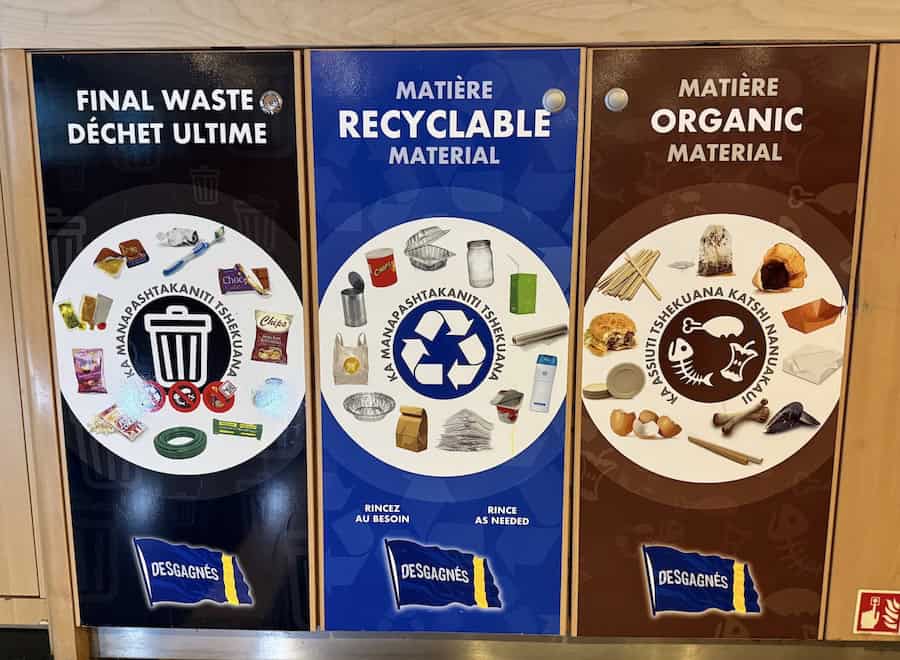
Recycling in French, English and Innu. * Photo: Aimée Laberge
We are now ready to start our week-long supply mission along the Gulf of St. Lawrence northernmost shore, the very same Jacques Cartier explored in 1534.
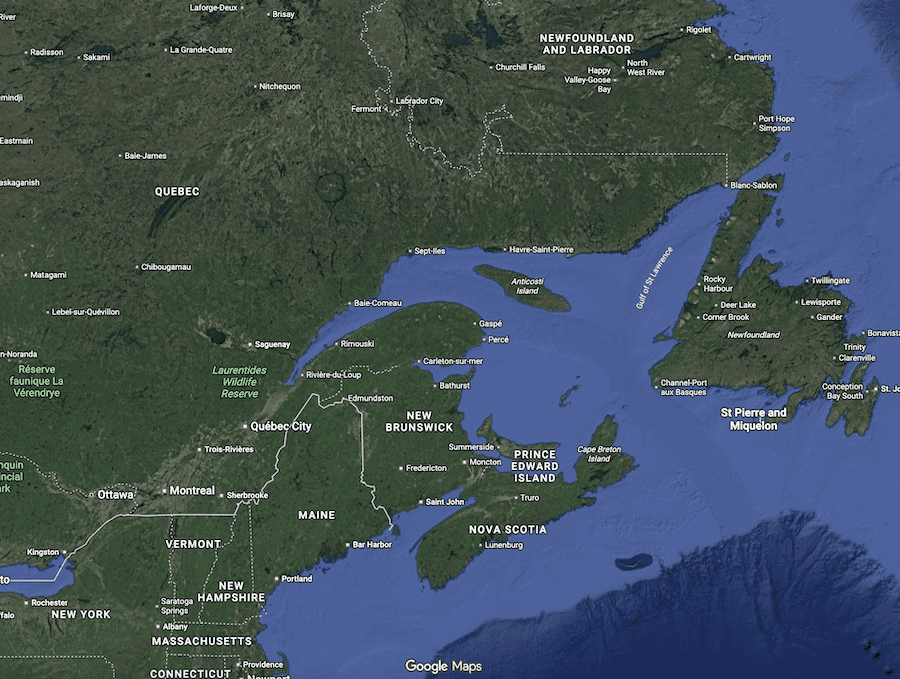
A map of the Gulf of St Lawrence. * Image: Google +Maps
The Story of the Desgagnés
For us, the name Bella Desgagnés has a special resonance. We spend the summer in a small village by the St. Lawrence seaway with a ship-building past. Many Desgagnés are in residence, some retired and some still seafaring navigators. When a ship goes by and blows its horn with three long blasts followed by two short ones, we know there is a Desgagnés aboard saying hello to his family.
Groupe Desgagnés is now a fleet 21-ships strong, each with a distinctive yellow slash on its dark blue hull, and each named after a woman in the family to ward off bad luck. The story begins in 1864 in Saint-Joseph de la Rive, when Zephirin Desgagnés starts to deliver goods to small communities along the St. Lawrence on his schooner, Mary Ann. In 2008, the MV Camilla Desgagnés became the first commercial ship to travel through the Northwest Passage. The MV Bella Desgagnés launched in 2013 and carries on the tradition.
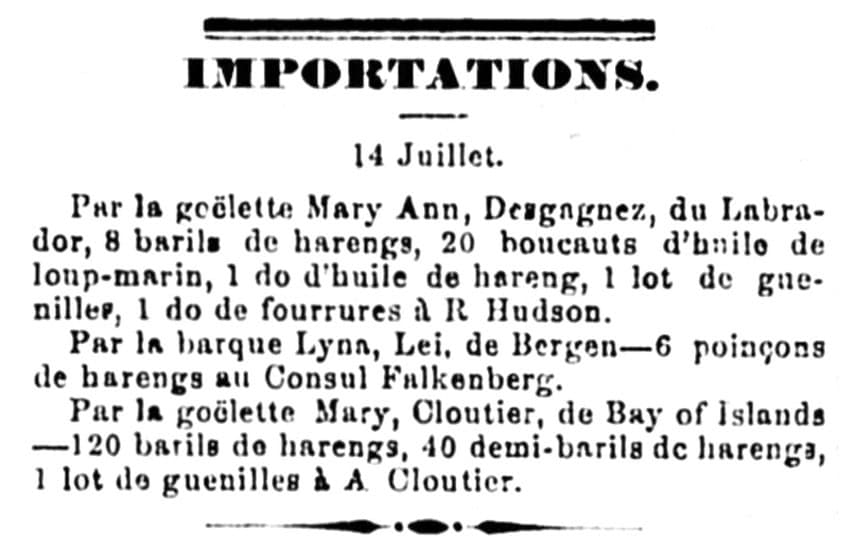
A 19th-century ad for the Mary Ann. * Image: Aimée Laberge
Day 2
- Sept-Iles — founded in 1662; population 25,000 including 3,500 Innu in Uashat and Mani-Utenam
- Port Menier, Anticosti Island — founded in 1680; population 200; deer population 180,000
Good news. The sun is up, the weather mild and the sea is calm, so no reason to worry about le mal de mer. We heard this cruise can be rocky at times, even with the ship’s anti-roll tanks and side stabilizers.
For now, we start the day with a big breakfast. If you don’t care for the regular menu of pancakes, crepes, oatmeal, yogurt or fruits, the special today is eggs Benedict with plenty of coffee. We are taken care of by Christina and Gabriel, both offering sunny side up smiles at this early hour.
Seven Islands
Right after breakfast, we dock in Sept-Iles, named after the seven islands laid out in front of this small city. We follow our guide, the on-board naturalist Rachel, while she explains that an international cruise ship terminal is getting built to accommodate ocean liners such as the Queen Mary. A brand-new center is ready to welcome visitors with a focus on the indigenous culture of the Innu, the largest indigenous tribe in Quebec.
Sea to Table
We come back for lunch and realize we will enjoy everything the sea has to offer twice a day. Clam chowder and breaded cod are my lunch choices. At dinner it will be marinated octopus and lobster pasta. I laugh when the staff tries to explain what’s a pudding chômeur to our English-speaking friends. Unemployment Pudding?!? Someone suggests Poor Man’s Pudding instead. It’s delicious, similar to tarte au sucre or tiramisu.
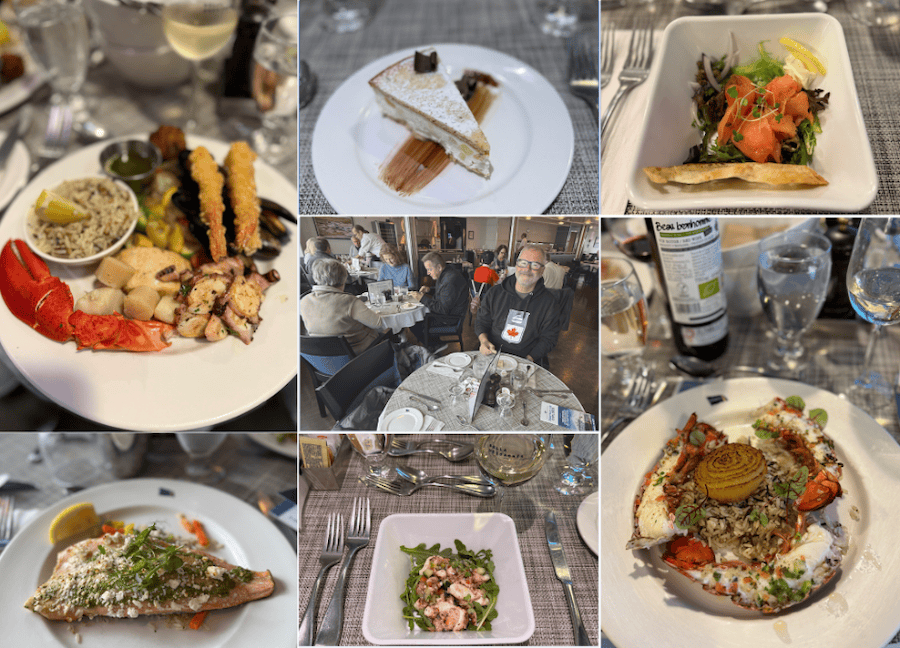
Meals aboard the Bella Desgagnés cargo passenger vessel. * Photo: Aimée Laberge
Chocolate & Château
Once we clear the safety drills given by the first officer, it’s smooth sailing to Anticosti Island. Port-Menier, its only village, is named after a French chocolate baron who bought the island with dreams of a private hunting ground. The chateau-like villa Henri Menier built might not be there anymore but the few deer he introduced, along with foxes, rabbits and more, have done well. You read it right: population 200 people and 180,000 deer!
We dock in the evening to walk the one-kilometer-long causeway back and forth in pitch dark. Once on land, we hear the deer hooves in the night but don’t see them. Rather than get back onboard, we watch how the crane operator, assisted by the crew, parks a dozen containers in a row with only an inch in between. Such precision. We will stop again at Ile d’Anticosti on our way back with more time to meet the deer.
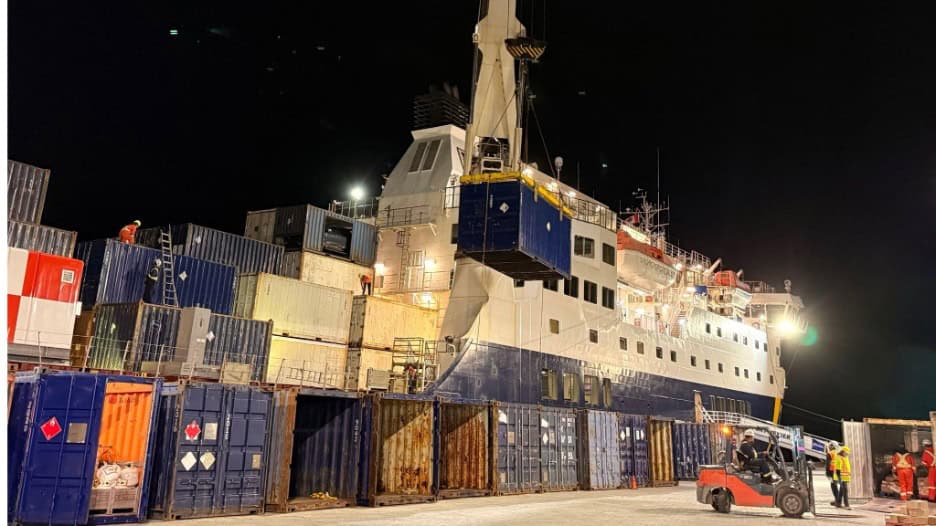
Cargo being loading on and off of the Bella Desgagnés cargo passenger vessel. * Photo: Aimée Laberge
Day 3
- Natashquan — founded in 1855; population 300
- Kegashka — founded in 1852; population 125
- La Romaine — founded in 1820; population 1,200 plus, including Uname Shipu
A Village at the End of the World
Gilles Vigneault, Quebec’s great chansonnier (poetic singer), called Natashquan le village au bout du monde (the village at the end of the world) for a simple reason. This is where the road stops, or did until recently, when it was extended 37 more miles to the Innu hamlet of Kegashka. Our stopover is a short 30 minutes. Vignault’s house is too far — 30 some minutes away by foot. Instead, we follow Rachel around docks covered with crab pots and surrounded by flat rocks where Labrador Tea and Tussock Cottongrass grow. We linger where bright green moss and lavender grass spread and lichens print tattoo-like patterns on the rocks.
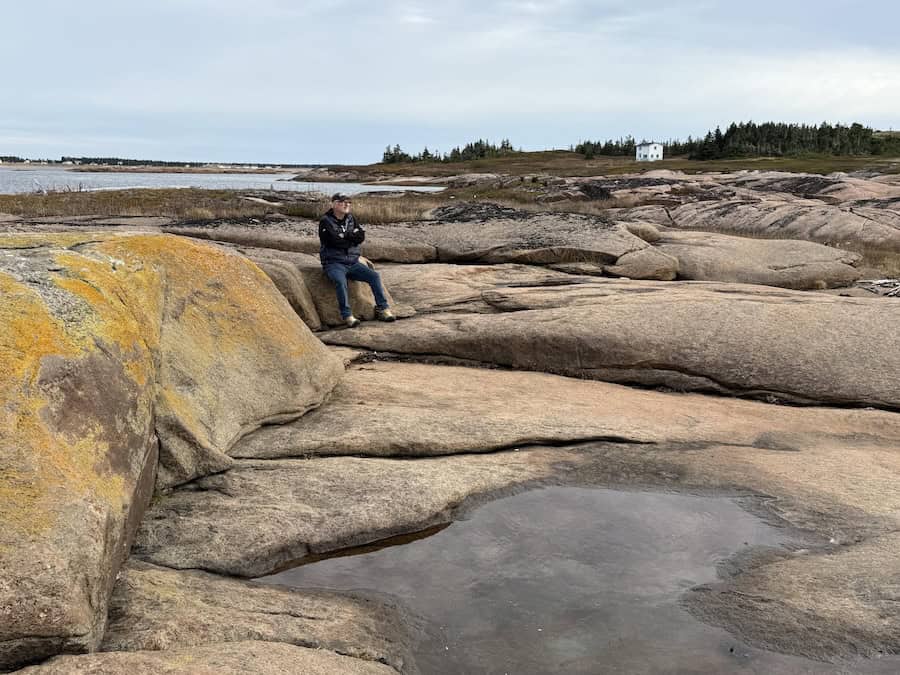
On the rocks in Natashquan. * Photo: Aimée Laberge
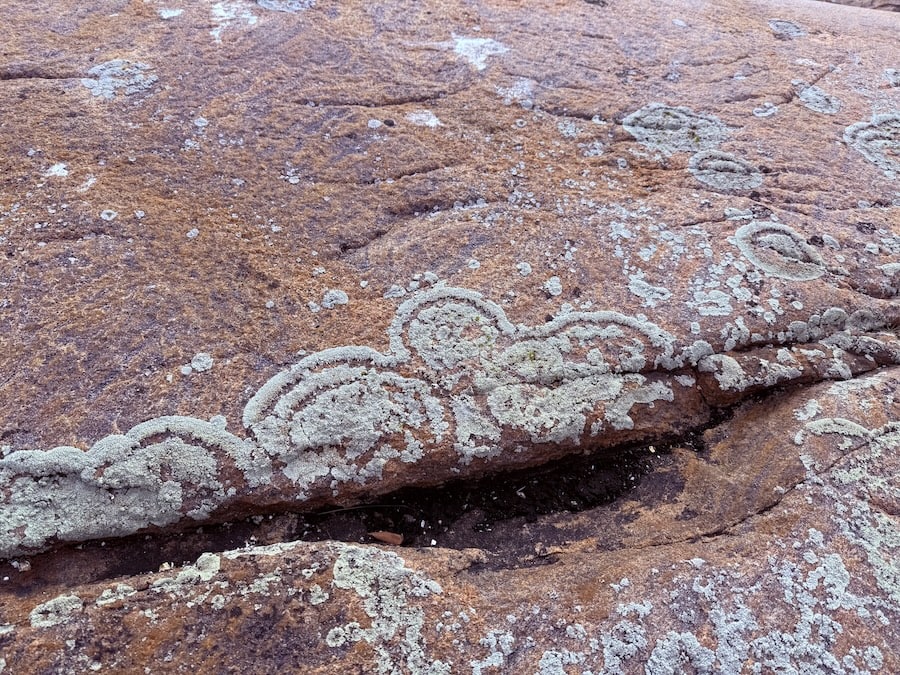
Natashquan lichen. * Photo: Aimée Laberge
We skip the Kegahska stopover because dinner, duck leg confit served with gratin Dauphinois, is too tempting. The three-course menu at lunch and dinner always offers sea, land or vegetarian options.
Next stop: La Romaine for a quick evening stroll.
The Stopovers & Excursions
One thing we learn quickly: both arrival and departure times for each stopover are fluid. Very fluid. We soon take the habit of going by the reception to check the latest posting for arrival and back onboard time. We remain docked only as long as it takes to load and unload the ship. A guided walk is always offered.
Tours can be booked with Voyage Costes to visit villages out of reach by foot. We never leave the ship without the guide telling us how far we are, in walking minutes, from the main attractions or trails in each village.
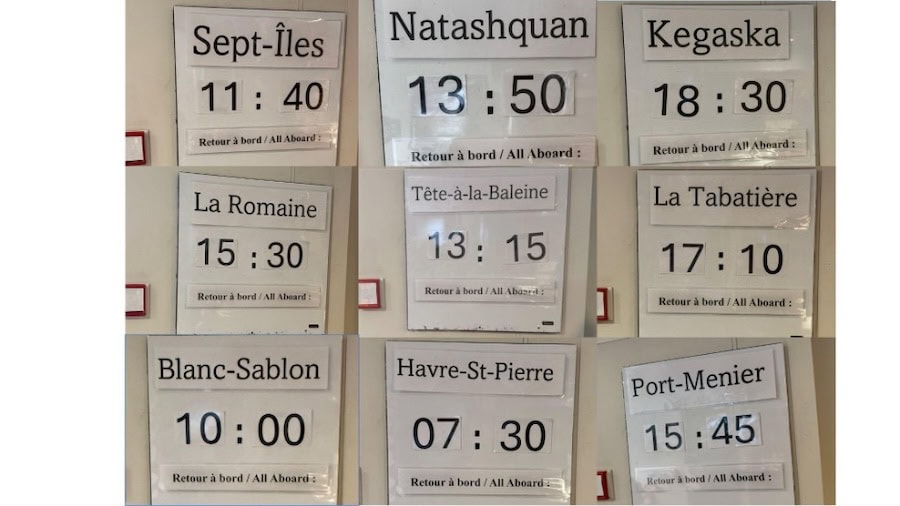
Keeping track of the ship's sometimes short port stops is vital. * Photo: Aimée Laberge
Voyages Costes Tours
Average price for tours are CAN $65. The website for Voyage Costes was down for a few days when we were on board and we found it difficult to navigate. The tour we succeeded to register for was cancelled at the last minute. It’s also possible to find local guides on the internet or searching on Facebook, but keep in mind these are small communities. To hitch a ride to the village with a local is a good option too!
Evenings in the Bistro
The Bistro is where the afternoon can be spent playing cribbage, solving sudoku, journaling or just reading before happy hour. In the evening, presentations start here with a short film with subtitles introducing us to the next day’s stopover, followed by a daily talk given by the naturalists, with an English version given in the Boardroom on Deck 6.
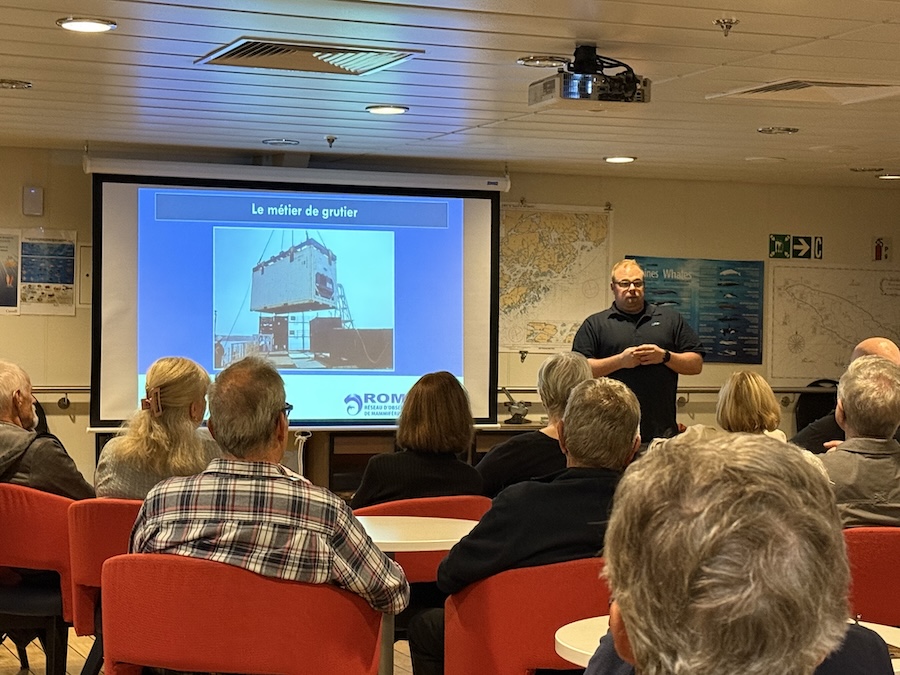
The French talk in the Bistro with Danny, the crane operator. * Photo: Aimée Laberge
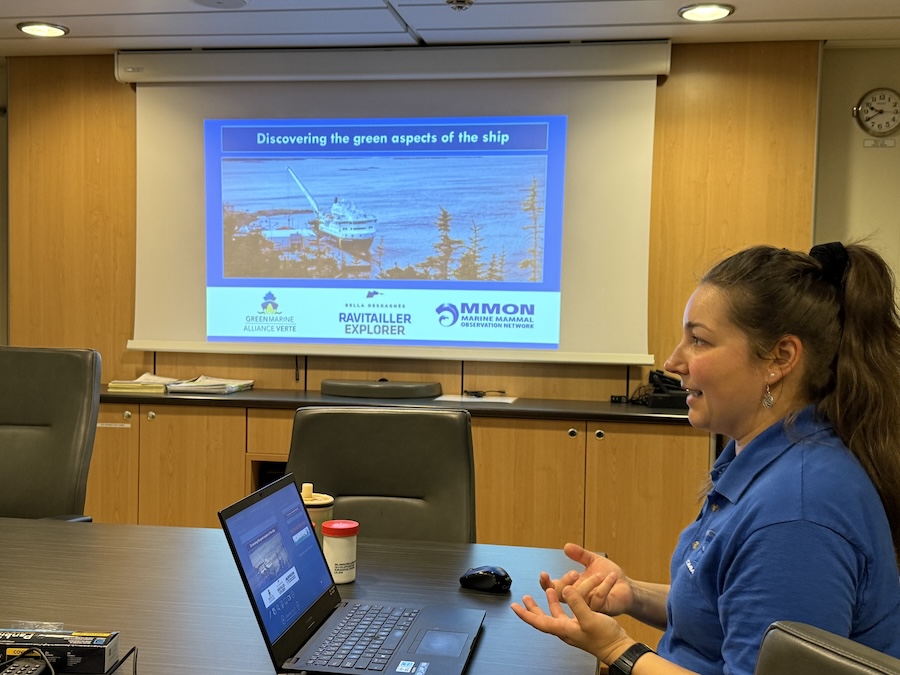
English talk in the Boardroom with Rachel. * Photo: Aimée Laberge
Sightings & Science
The blackboard behind the bar in the Bistro lists all the wildlife observed on the day. Today we came across more than 50 black back and white-beaked dolphins dancing in and out of the water. Soon a humpback whale joined in. It was all 0oohs and aaahs on the observation deck when we saw her spout and her tail. Five more were spotted.
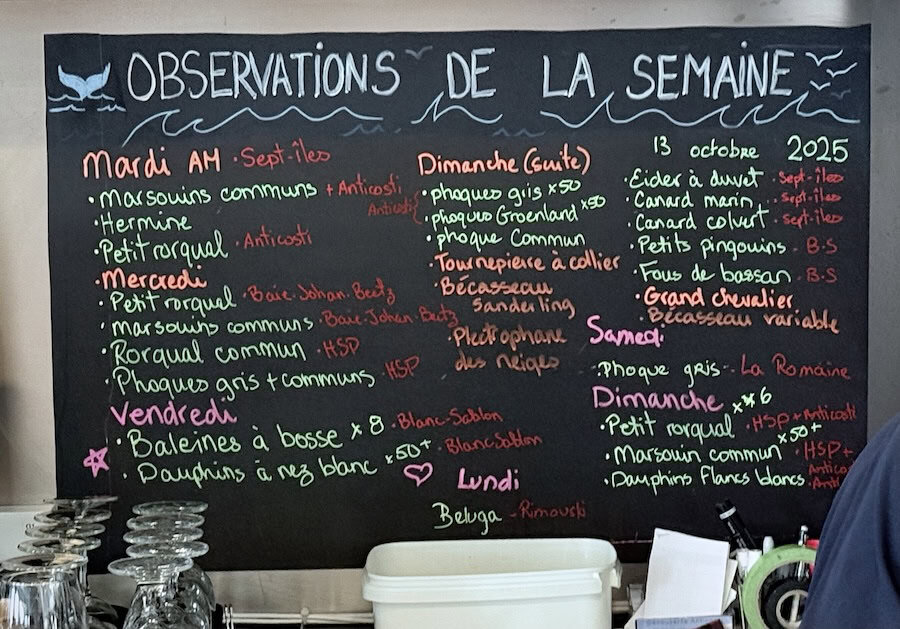
The Bistro's blackboard. * Photo: Aimée Laberge
Later in the week we will sail beside close to a hundred playful porpoises feeding along with half a dozen common Minke whales. When this occurs, the ship’s heat-imaging technology snaps a picture of the whale and sends it to a Florida partner where ID is done. The information is sent back at the speed of light and received with a ping in the wheelhouse.
A nonprofit organization, the Marine Mammals Observation Network’s mission is to protect and preserve the whales and seals of the St. Lawrence and their habitats. Ships go where scientists can’t, making them an essential partner.
The Bella Desgagnés also contributes to MARS, the marine acoustic research station. Usually cruising at around 12 knots, the freighter slows down to 10 knots in the presence of marine mammals and when sailing through the black whales protected areas to lower noise and avoid possible collisions. To learn more about these projects go to, Navigating Whale Habitat.
Day 4
- Harrington Harbour — founded in 1871; population 205
- Tête-à-la Baleine — founded in 1820; population 120
- La Tabatière — founded in 1820; population 350
Harrington Harbour
It's a big day with three stopovers.
In Harrington Harbour, there are no roads and no cars. Two guys are busy nailing new boards on the wooden walkways while moms are driving their kids to school on their All-Terrain Vehicles. High school students have to take a motorboat to the next village. The late ones might be lucky enough to catch a ride on the helicopter, the only other mode of transportation available.
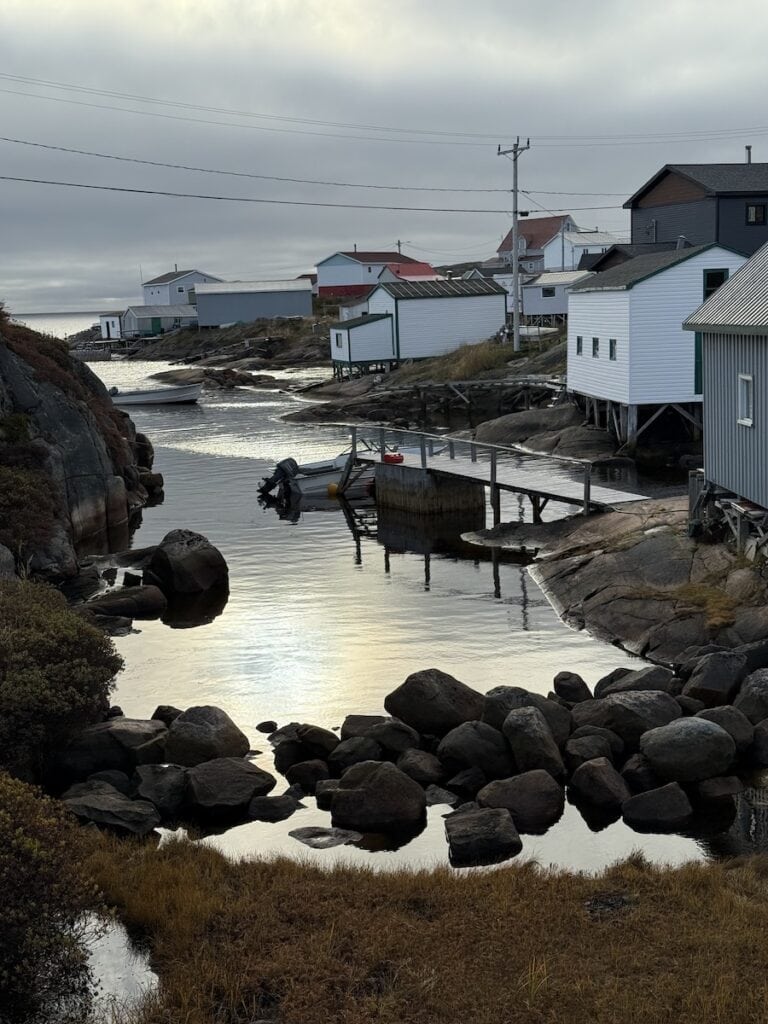
Harrington Harbour. * Photo: Aimée Laberge
This picturesque fishing village is a star. It was made famous by the cult Quebec film La Grande Seduction (aka Seducing Dr Lewis), where villagers deploy hilarious machinations to trick a visiting doctor into staying. It is also the inspiration for Griffin Creek in Les Fous de Bassan by award-winning author Anne Hébert. A mysterious sign points to Marguerite de la Roque’s cave. Who is she? Yet another character based in this village, she's the pupil of Nouvelle-France explorer Roberval. The story says he abandoned her on an island with her lover, where they sheltered in a cave during winter. You want to know who survived? Read Isola by Allegra Goodman, published last year, to find out.
Meanwhile, Captain Deveau has to toot the ship’s horn to call us back on board.
Tête-à-la-Baleine
A guided visit of “Whale’s Head” village, 11 km away, is organized by Voyages Costes. We opt to follow Rachel on a trail going uphill on bare pink rock instead. No trees here but deer moss looking like large snowflakes where clumps of poivre des dunes are growing. We descend towards a small cove where the calm water permits starfish gazing. We wave to a couple heading out to their island cabin on a motorboat. They look happy. We do too.
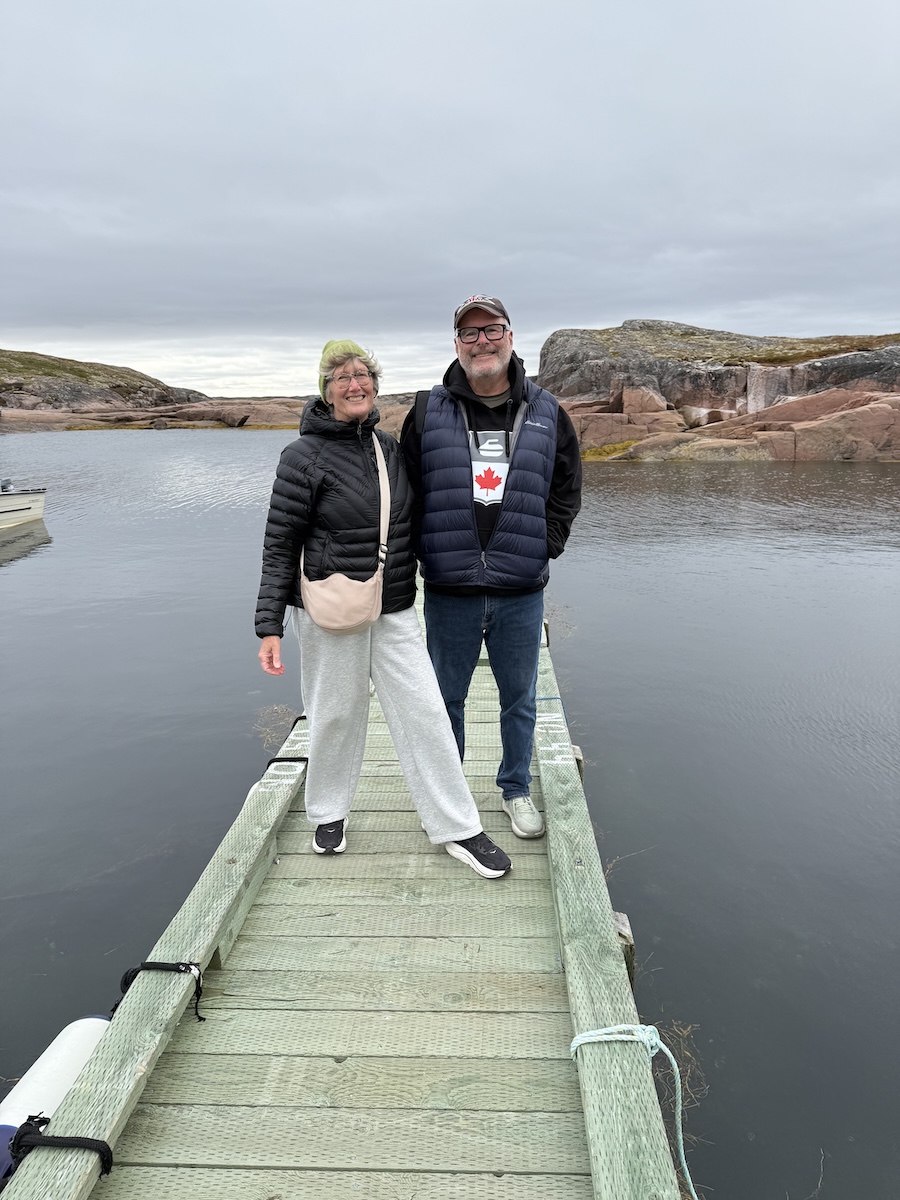
Aimée and her husband in Tête-à-la-Baleine. * Photo: Aimée Laberge
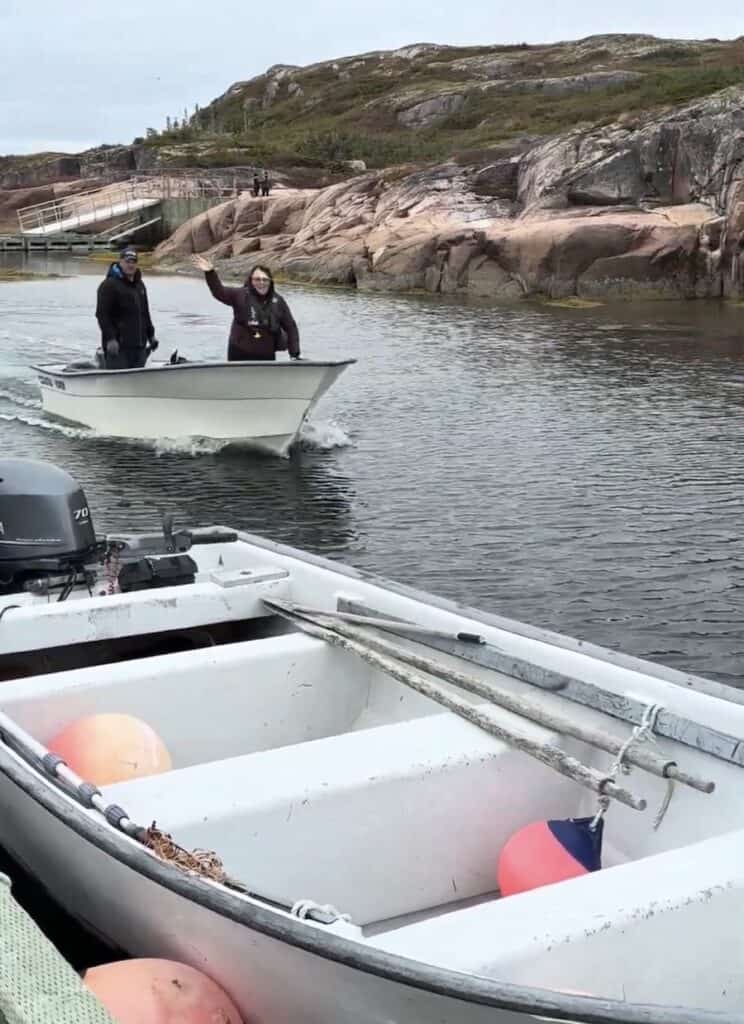
Tete a la Baleine, marina. * Photo: Aimée Laberge
La Tabatière
Don’t be fooled. A day passenger tells us that “La Tabatière,” an English-speaking village, is pronounced “Law Tibettcheur.” The origin of the name has nothing to do with tobacco either; it comes from the indigenous word “tabaquen,” meaning shaman. We take a staircase and climb a steep hill during our voyage’s only rainy afternoon. Dinner is restorative after an eventful day, with smoked salmon, choice of halibut or prime rib, and, why not, a well-deserved piece of sugar pie.
Day Passengers
The Bella Desgagnés ferries locals from one community to the other. The freighter is the main link where there is no road. The local voyageurs stay in a salon with large, comfortable airplane style seats, each with a screen, and in the cafeteria.
There are public showers if they stay over more than a day. If you would wish to, and if you were frugal, you could to the 7-night cruise sleeping in the salon instead of in a cabin with meals taken in the cafeteria. Friends of my sister did this a while back.
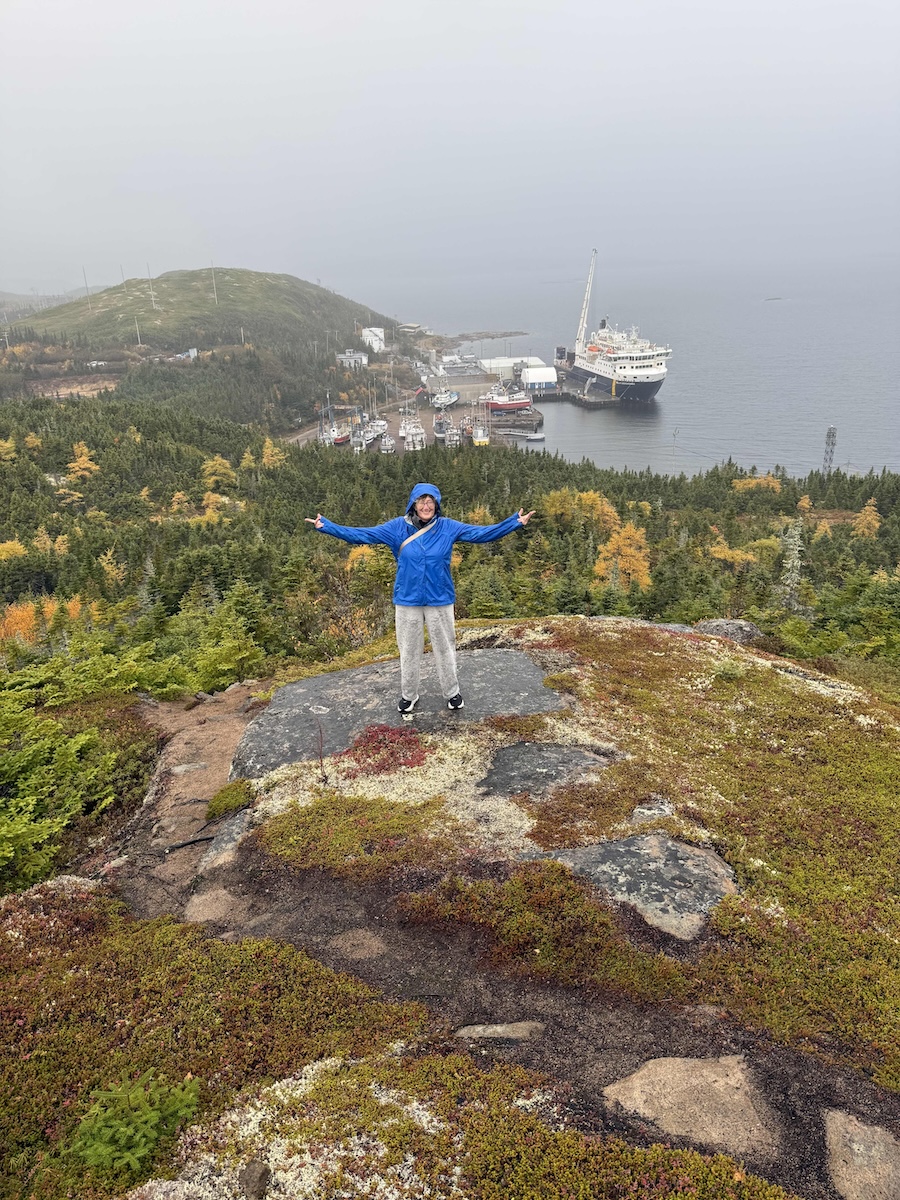
Aimée in La Tabatière. * Photo: Aimée Laberge
Day 5
- Blanc-Sablon — founded in 1854; population 1,125
- Saint-Augustin — founded in 1820; population 425
- Pakua Shipi — population 237
The Last Stop in Quebec
Named for its white sand beach, Blanc-Sablon is the last village in Quebec before Labrador. A ferry leaves from here to Newfoundland, only 35 km away, across the Strait of Belle Isle where icebergs drift in the spring. We hang out on the dock, busy with fishermen’s boats and their catch. What’s in these big orange containers, we asked the forklift operator. He obliges by opening one, full to the brim with herrings.
The captain of a boat waiting to go in dry dock for winter invites us onboard telling us about the changing nature of the trade: the cod stock has not recovered yet, the Nordic shrimps are overfished, and the real money is in crab and lobster. Guess what we’re having for dinner tonight?
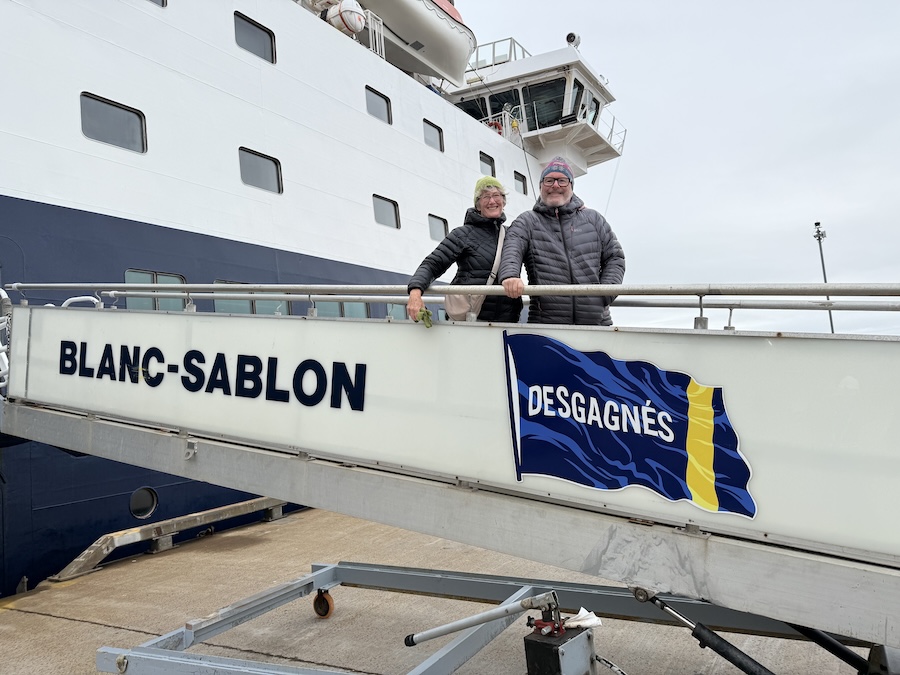
Blanc-Sablon, the last stop. * Photo: Aimée Laberge
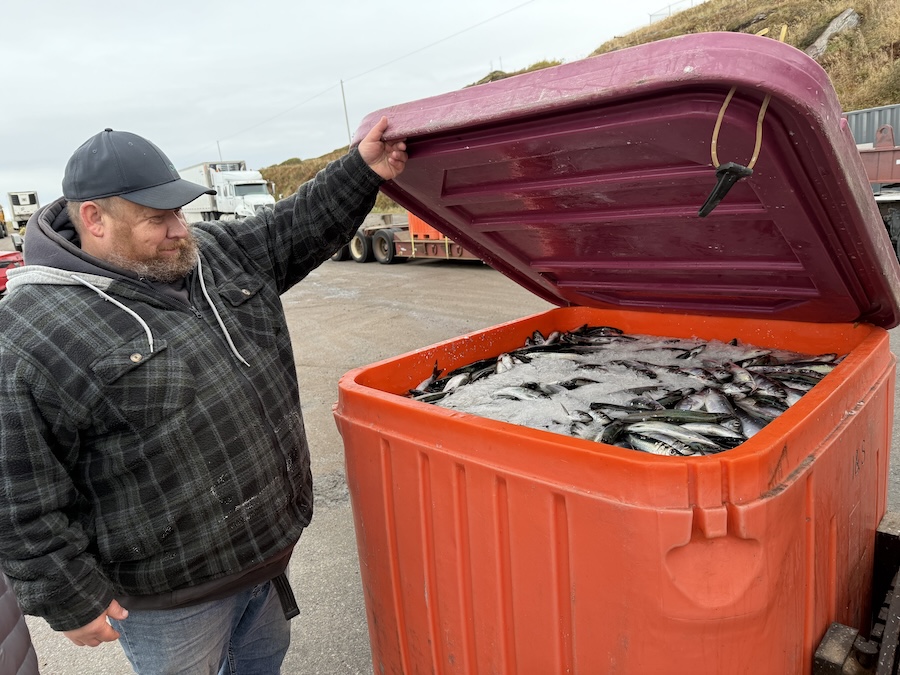
Herrings in Blanc-Sablon. * Photo: Aimée Laberge
St. Augustin & its Rigolets
We are told to expect spectacular navigation, so we head to the observation deck as we approach our next stop. We glide through a maze of small fjord-like sea arms and islands, sometimes with only a few feet between ship and rock walls. Once we get to the quay, the crane is on the wrong side so Captain Deveau turns the ship on a dime thanks to its two azimuth thrusters.
All this before going on a tour of the most beautiful garden in the world: northern peat moss, also called red bogmoss or small red peat moss. A 10-foot-deep bed of moss can be up to 10,000 years old, and its flowers, some carnivorous, can take 10 years to grow. Keeping this in mind, we thread as lightly as we can on a land covered with the softest carpet, with more snow-like deer lichens growing besides patches of mousse ranging in colours from salmon pink, ruby red and maroon to almost black. Next to the road, the rocks have been painted in even brighter colours, an art project from the Pakua Shipi students.
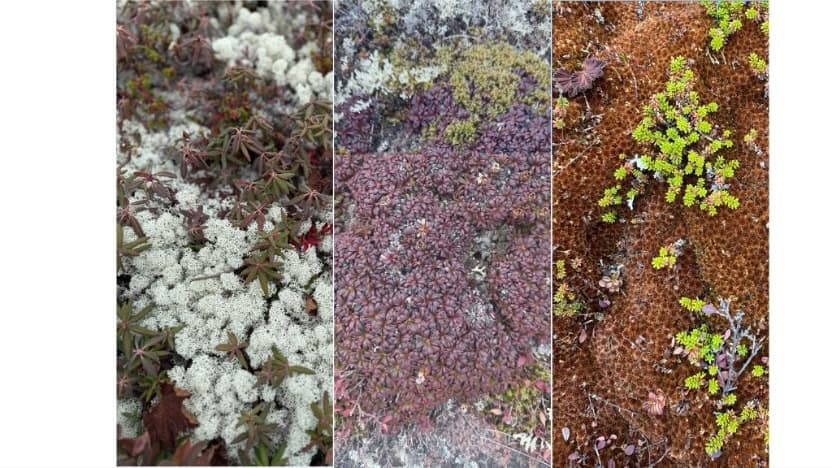
Lichen galore! * Photo: Aimée Laberge
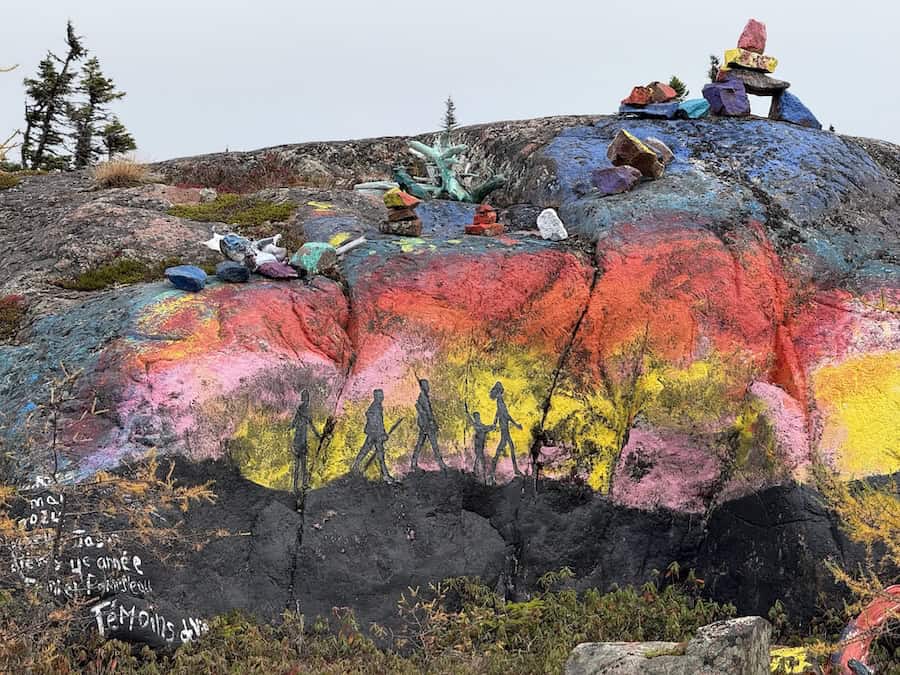
Painted Rocks in St. Augustin. * Photo: Aimée Laberge
Captain Deveau & Danny, the Crane Operator
Born in Nova Scotia in a family of lobster fishermen, Capitaine Corey Deveau has spent 14 years sailing the Gulf, seven as Bella Desgagnés’ captain. The Acadian has observed climate change firsthand. More winds from the south have brought warmer temperatures, but also more frequent, and more violent storms. Last October saw three in the same week, with 60 knots-wind interfering with the operations. A ship like the Bella can break new ice, but if a northwest wind brings multiyear ice from the Greenland, the goings get tough and the toughs call for a Coast Guard ice breaker, such as the NCCG Amundsen.
Another change, besides climate: an explosion of the number of tourists onboard in the last five years. The crane operator’s presentation is also a hit. Everybody is interested in the complex logistics behind the loading and unloading operations — what with keeping an even keel between fuel, ballast, water… or making sure the container clears the dining room window! Danny goes back to work after his talk, with night stops in La Tabatière and Tête-à-la-Baleine.
Day 6
- Harrington Harbour
- La Romaine
- Kegashka
- The White Road
Early risers are rewarded with a second opportunity to get the best picture of Harrington Harbour. It’s 6:30 am, and much quieter than last time we visited at the start of the cruise. We have the boardwalks to ourselves, and an invitation to meditate about what life must be like, here, in winter. The custodian at the ice rink tells us it’s the most social season. Each village, linked by la route blanche (the “White Road,” a well-known snowmobile route in these parts), stages its own hockey tournament and the Coasters arrive on snowmobiles after crossing frozen rivers. But last year the White Road was only open for two weeks.
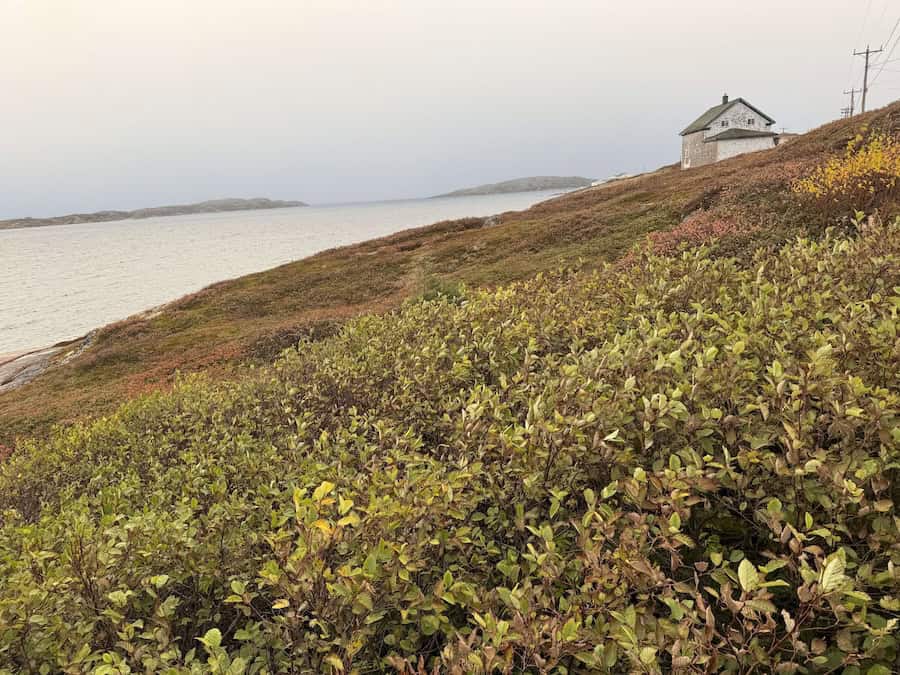
Harrington Harbour in the morning. * Photo: Aimée Laberge
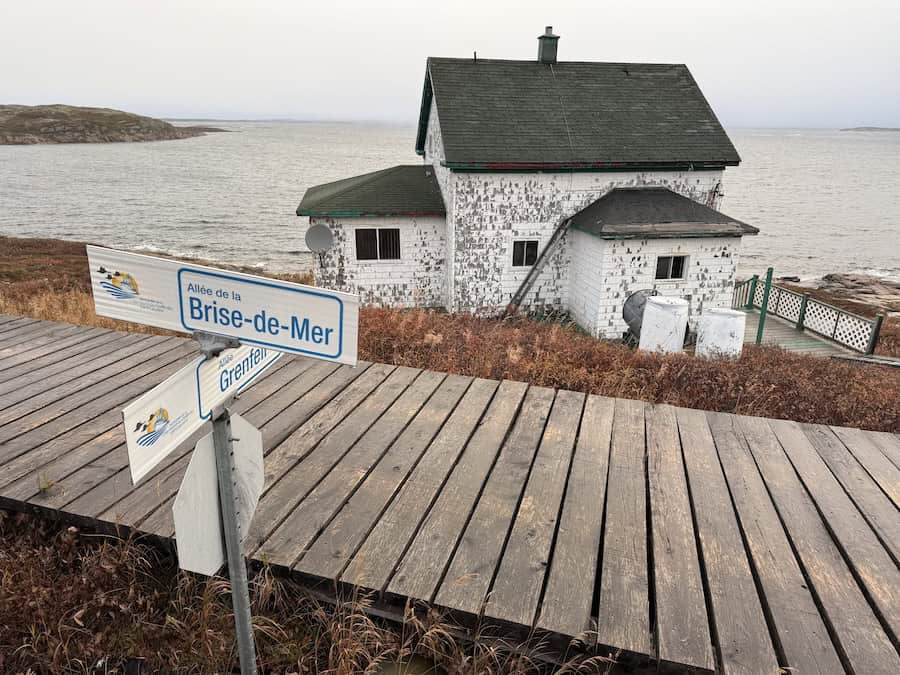
Brise-de-Mer in Harrington Harbour. * Photo: Aimée Laberge
Making Friends
I skip the stop in La Romaine to ask the three siblings travelling with their partners in the English-speaking group why they decided to take the cruise. First, this was an opportunity for a family reunion, the Canadians say. But like me, their interest in the Bella Desgagnés is rooted in past experiences at sea.
Gordon never forgot cruising along the Gulf of St Lawrence from Halifax to Montreal on-board the destroyer HMS Iroquois when he was in the Navy. He had promised himself he would come back and here he was, happy as a clam during the visit of the wheelhouse, and always the one with the most technical questions for the crew.
For Dixie, it was the memory of her parents taking her out of school when she was 13 to board a mail freighter going from Seattle to Japan. She loved riding the dish-breaking storms and the long days at sea. “It’s not the destination, it’s the journey!” She says with a spark in her eyes.
Linda already knows most of the crew by name and marvels at their joie de vivre. She spends as much time as she can watching the loading operations. “It’s like Tetris!” Tetris done with a spreader, lock switches and two long ropes.
People who love ships love the Bella!
Hitching a Ride in La Romaine
When I go back to the cabin my husband greets me in Innu: Kuei! Having ventured a little too far from the ship and afraid to miss the boat, he lifted his thumb and was given a ride by an Innu family in a pickup truck. He won over the children, shy at first, by asking them to teach him a few words. Unamen Shipu is the largest First Nations community on the coast. Here, one church serves the French inhabitants, Eglise Sacré Coeur, and the other, Eglise Marie-Reine-des-Indiens, the Innu community.
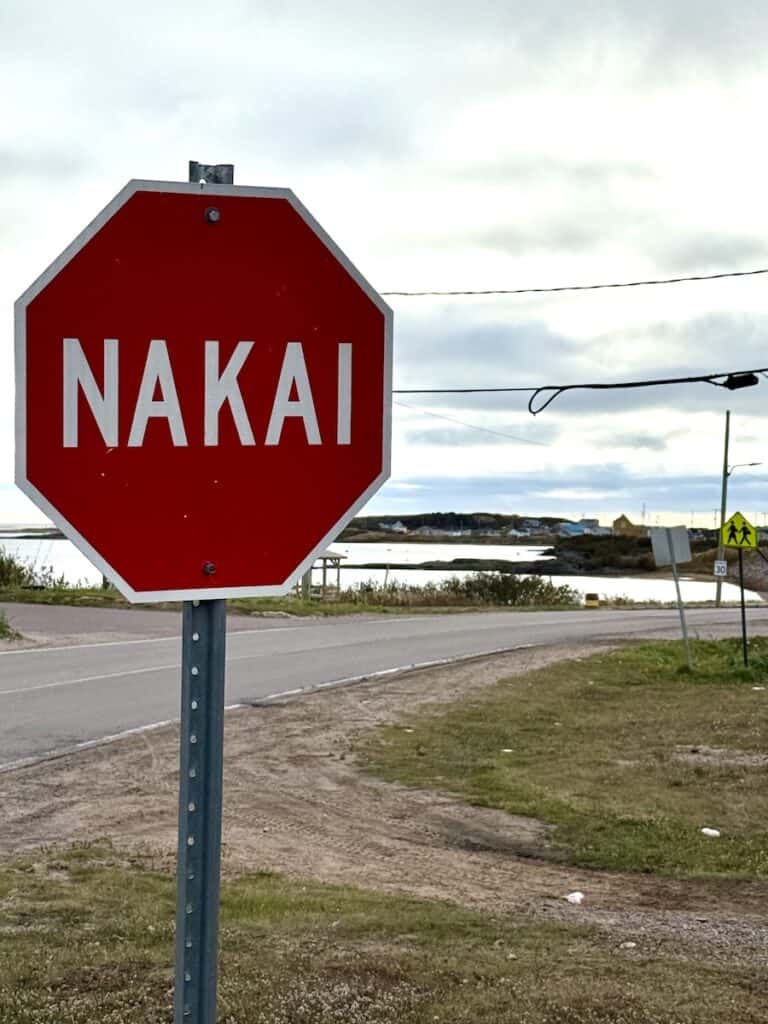
Stop Sign in Unamen Shipu. * Photo: Aimée Laberge
Day 7
- Havre St-Pierre — founded in 1857; population 3,300
- Port Menier, Anticosti Island — founded in 1680; population 200
Havre St Pierre
I skip breakfast to walk around Havre Saint-Pierre, the only one of our stopovers able to welcome large cruise ships. I order a latte at a cute coffee shop and buy Labrador tea leaves for infusions and chicoutai, or cloudberry jam, at the souvenir shop.
The harbour is quiet, drowned in mist. No wind. I sip my latte and breath in the sea. How lovely. Breakfast at the cafeteria is not too shabby either: tomato bacon sandwich on toasted white. On to our much-awaited stopover on Anticosti Island.
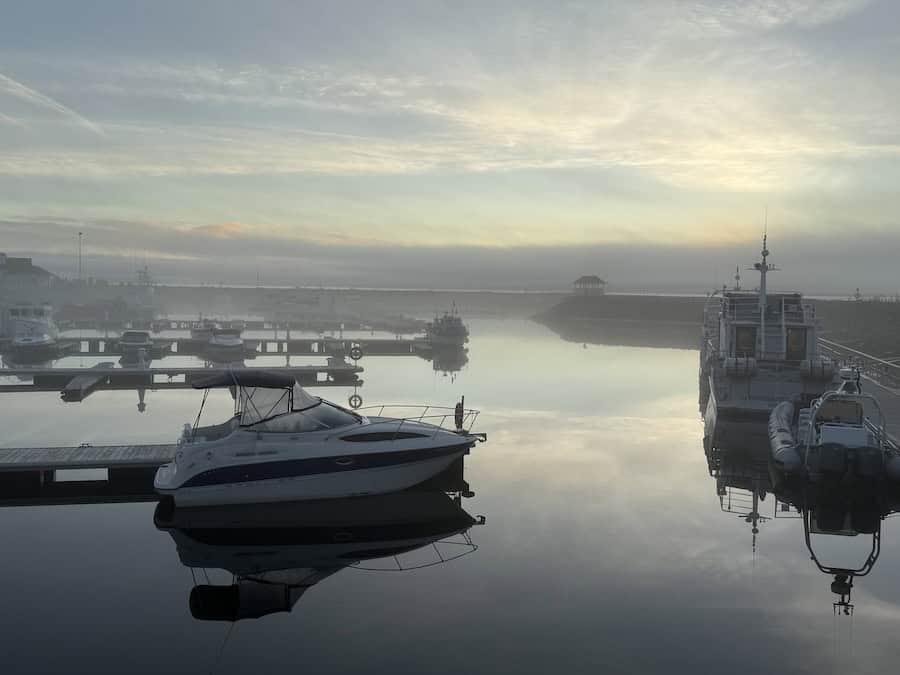
Havre St. Pierre, in the morning. * Photo: Aimée Laberge
Meeting the Deer… and the Foxes!
The sun shines and the temperature is exceptionally balmy when we arrive at the end of the causeway. The shallow bay is alive with migrating birds. We join France and Henriette on a tour they booked with local guide Lynn Lemire. The deer are everywhere. If they don’t come to eat in your hand, then they forage through our van to find a bag of chips left open. This is before they end up served for dinner. Each islander is allowed to kill four per year, a cheaper option than beef sold for $30 a pound.
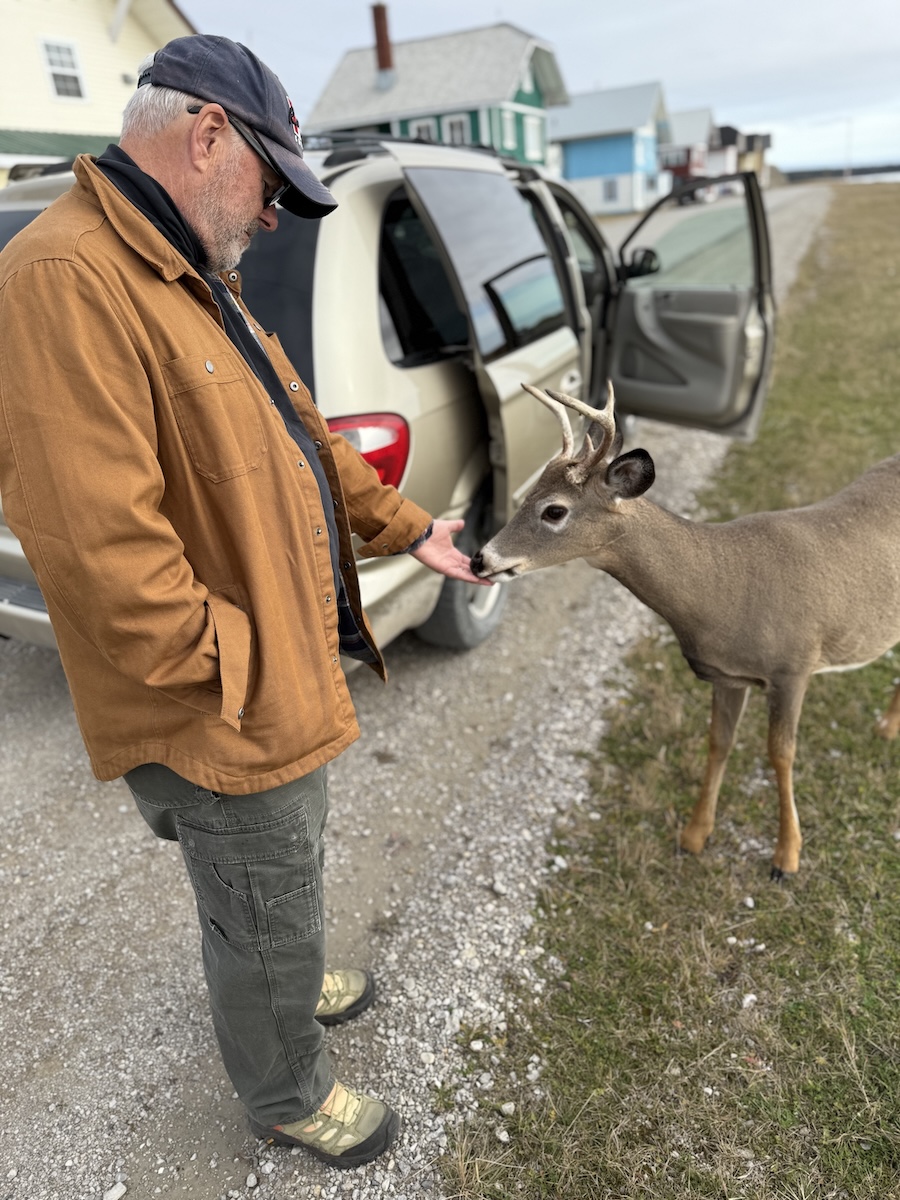
Kevin's new friend! * Photo: Aimée Laberge
Foxes of undefined lineage, their fur black, silver and red, run around like cats. Scared of Lyme disease? There are no tics, no fleas and no rabies on Anticosti. And of course we hear more about Henri Menier. His château might be gone but not the houses in a village he founded and supported. We watch a flock of dunlin flashing white and dark in flight before landing along the shoreline and pick fossils straight out of the gravel on the road.
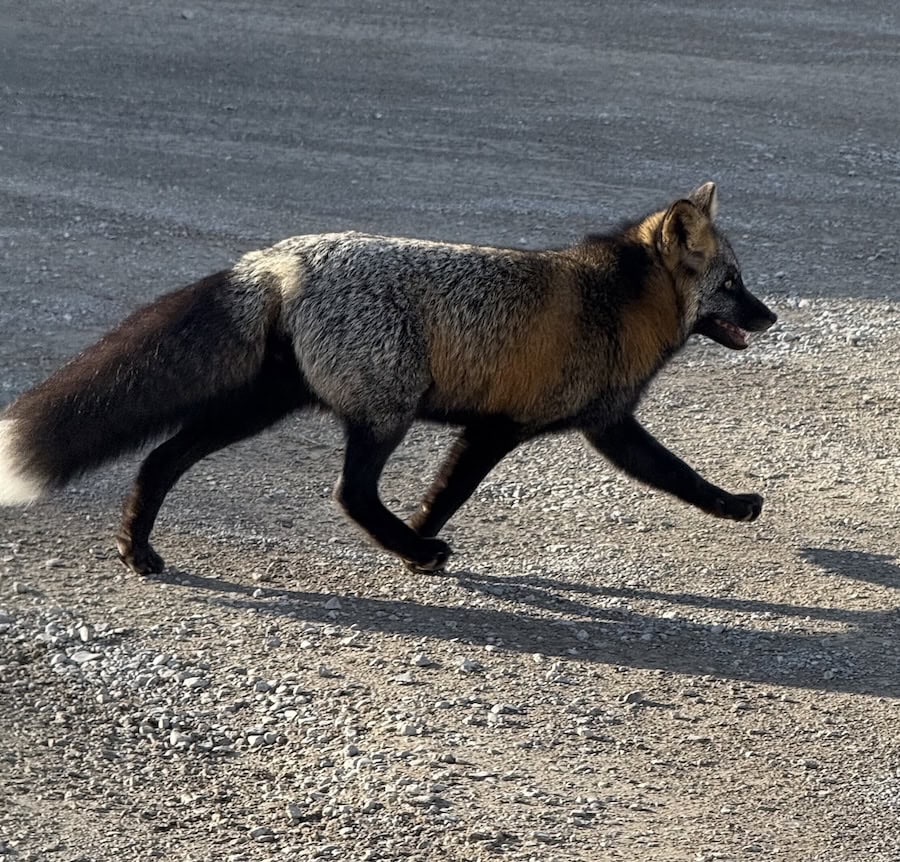
Anticosti Island Red, Silver and Black Fox. * Photo: Aimée Laberge
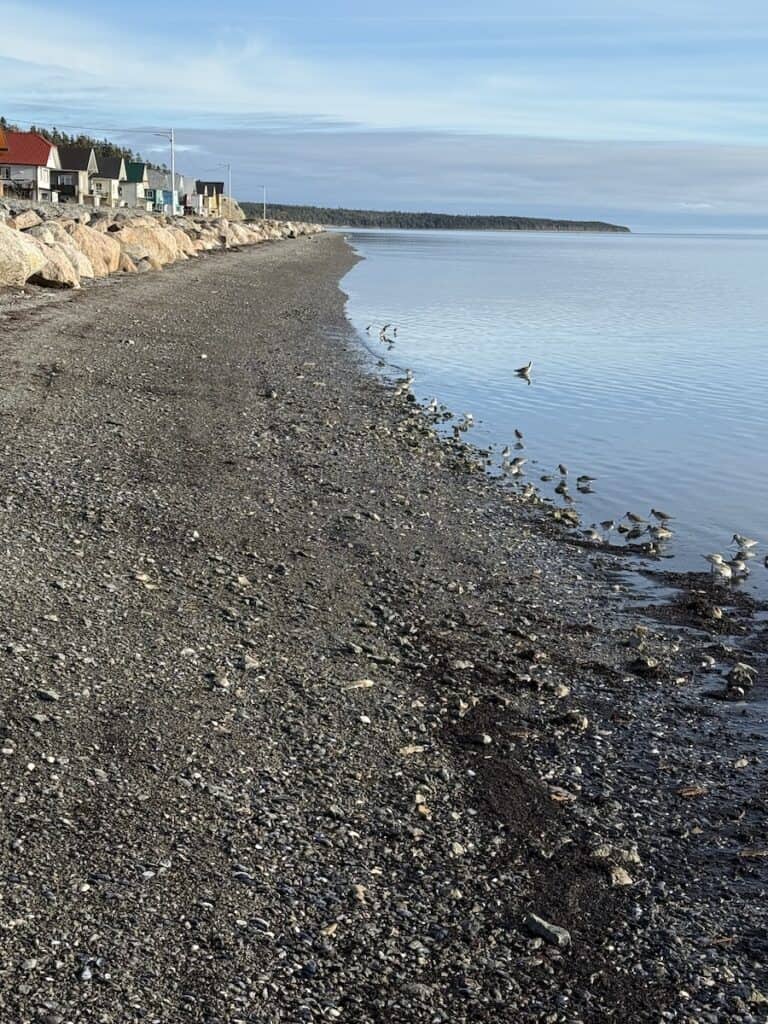
Anticosti Island with dunlins. * Photo: Aimée Laberge
We leave, enchanted, after purchasing a large Menier chocolate bar made in France at the grocery store.
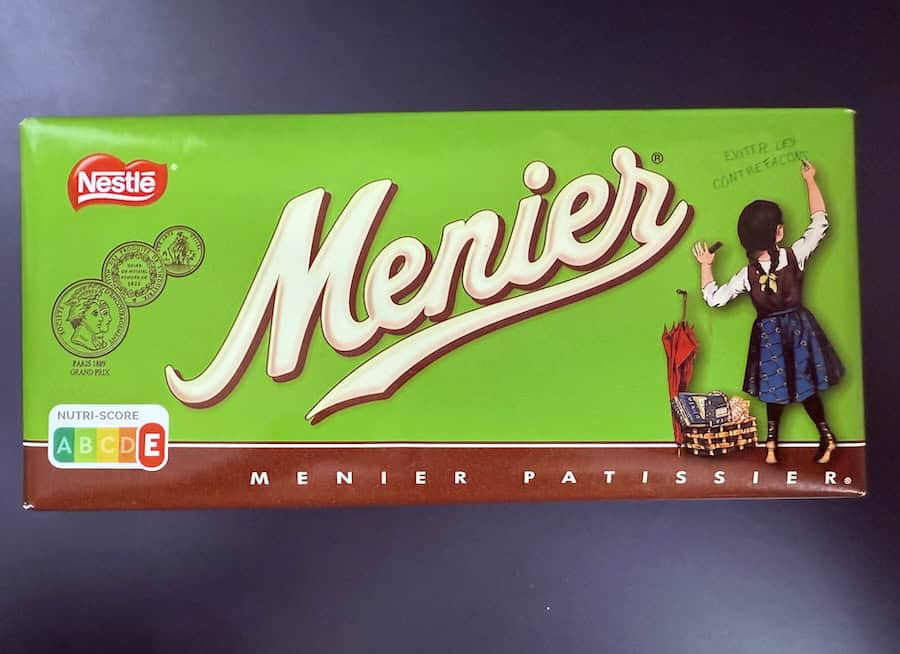
Chocolat Menier. * Photo: Aimée Laberge
Farewell to the Very Special Bella Desgagnés
Tomorrow we will have one last breakfast before clearing our rooms and watching Rimouski come into view from the observation deck. We will thank the dining room staff, Charlene, Eric, Christina and Gabriel, for having made our daily meals so enjoyable. We will exchange e-mails with new friends before saying goodbye.
We will soon return to our daily lives after having gone where the road doesn’t and where the Bella Desgagnés makes it possible for small, isolated communities to feel like one and to thrive. This is what makes this cruise such an unusual experience.
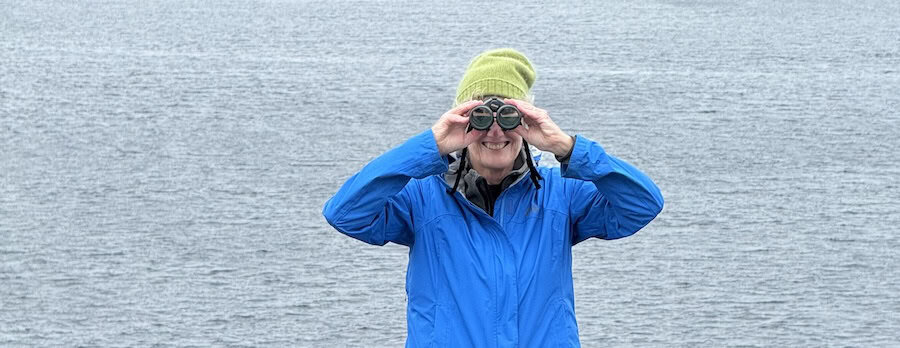
Exploring New Worlds! * Photo: Aimée Laberge
Interested in This Quirky Bella Desgagnés Cargo Passenger Cruise?
Here are some details about season and price:
The Bella Desgagnés sails all year except for February and March. We cruised mid-October, 2025. High season is mid-June to end of August; regular season is mid-May to mid-June and September; any other date is low season.
The 7-night Bella Desgagnés cargo-passenger cruise fares include cabin accommodation, three meals per day, plus daily walks led by a naturalist. Per person fares range from CAN $2,000 to $3,200 ($1,425 to $2,280 USD.) Alcohol is not included and cannot be brought onboard but is available for purchase on the ship. Gratuities are not included (suggested tip for the dining room staff is CAN$200 per passenger; tips for nature guides and cabin stewards are left up to you). You must make your way to Rimouski for departure, a four-hour drive from Quebec City airport. Cars are parked free of charge on the dock.
Reservations are open for 2027, with only select last minute low-season availabilities in 2026, which are posted on the company website. Bookings must be made directly with Relais Nordik.
Quebec born and bred, Aimée Laberge has been promoting French and Francophone cultures for 15 years, including, until recently, in her role as director of programs at the Alliance Francaise de Chicago. She now shares her time between Chicago and a little green house overlooking the St. Lawrence’s shipping lanes in Saint-Joseph de la Rive. Her favorite occupations: writing, travelling, and writing about travelling — when she is not distracted by her MarineTraffic app! Aimée Laberge was made Chevalier in the Order of Arts and Letters by the French government in 2025.












 HEIDI SARNA


